How to get out of debt in India: a step-by-step plan
A simple 7-step plan to get out of debt in India, with a family's 5 loans worked out in rupees: from 50 months to debt-free in 21.

Getting out of debt can feel impossible when several loans, cards and due dates pile up at once. But it almost always comes down to the same few steps, done in the right order. You don't need a big salary rise or a miracle. You need a clear list, a simple plan, and the patience to follow it every month.
Here's a 7-step plan that works for most Indian families, with a real example in rupees.
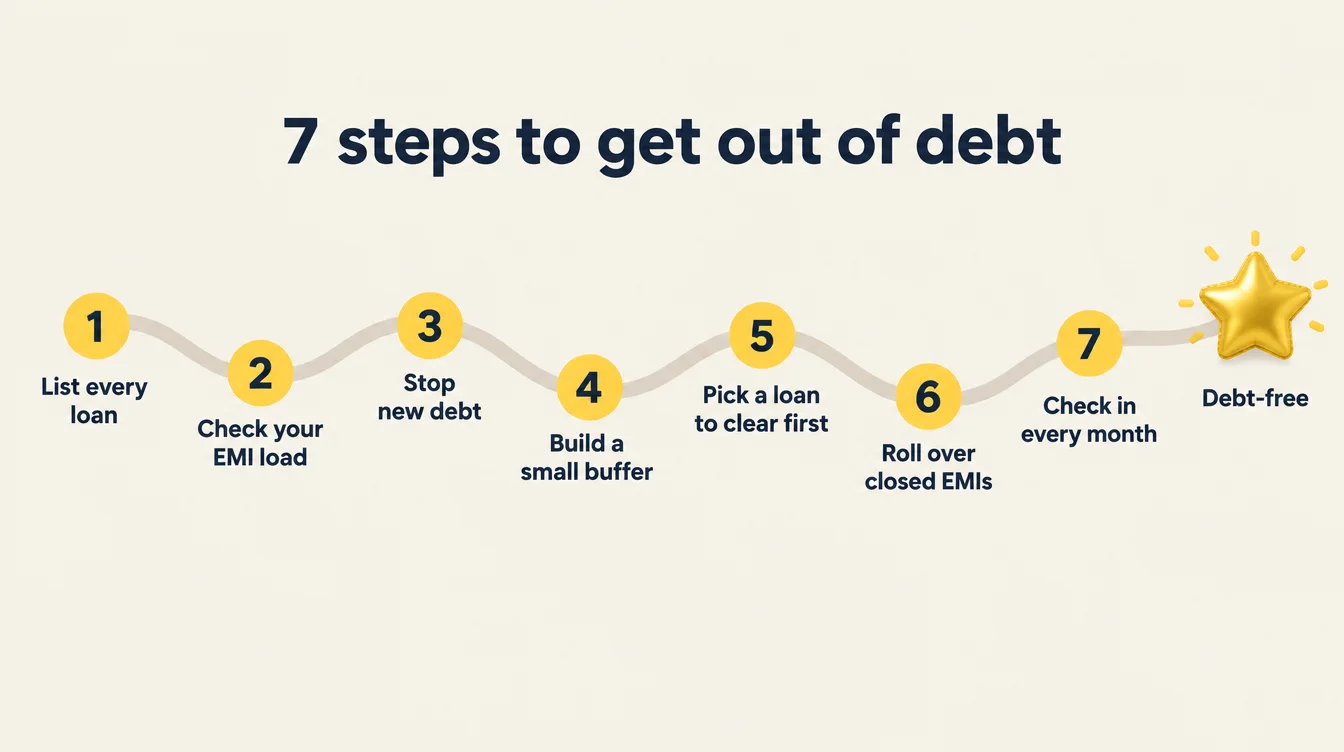
Step 1: List every loan, in one place
Write down every debt: bank and NBFC loans, credit cards, gold loans, phone and appliance EMIs, pay-later, chit funds, and money borrowed from family or friends. For each one, note what's left, the EMI, the due date and the interest rate.
Most families are surprised by the total. That's normal. You can't plan around what you can't see. Our guide on how to manage multiple EMIs has a simple format.
Step 2: Check how heavy your EMI load is
Add up all your EMIs and divide by your take-home pay. Under 30% is comfortable; 30–50% is stretched; above 50% is high risk. We explain the bands in how much EMI can I afford on my salary.
Step 3: Stop adding new debt
No new loans, no new phone on EMI, no new pay-later, and no new spending on cards you're paying off, until the plan is under way. Be careful with "No cost EMI" offers, which aren't fully free. And never borrow from an unknown loan app to repay another loan: that's how loan app traps begin.
Step 4: Build a small buffer
Set aside a small amount, ideally one month of EMIs, in a separate account. It stops a bad month from becoming a missed EMI, with bounce charges and a hit to your credit score. If that feels like too much, start with ₹5,000 and build it slowly.
Step 5: Pick which loan to clear first
Keep paying every EMI and minimum due. Then put any extra money on one loan at a time:
- Avalanche: the highest interest rate first, usually credit cards. It saves the most money.
- Snowball: the smallest balance first. It closes a loan sooner and keeps you motivated.
We compare both with full numbers in debt snowball vs avalanche. If you're paying only the minimum due on a card, fix that first: it can take 16 years to clear.
Step 6: Roll every closed EMI into the next loan
This is the step that changes everything. When a loan closes, don't spend the freed EMI. Add it to the next loan on your list. Each loan you close makes the next one go faster.
Any windfall, like a bonus, can go the same way. See Got a Diwali bonus? Prepay your loan or keep the cash?
Step 7: Check in every month
Pick one day a month, ideally just after salary day, to tick off the EMIs, see what's left and adjust the plan. If you share loans with a spouse, do it together; our guide on how to talk to your spouse about debt can help start that conversation.
A worked example: the Sharma family
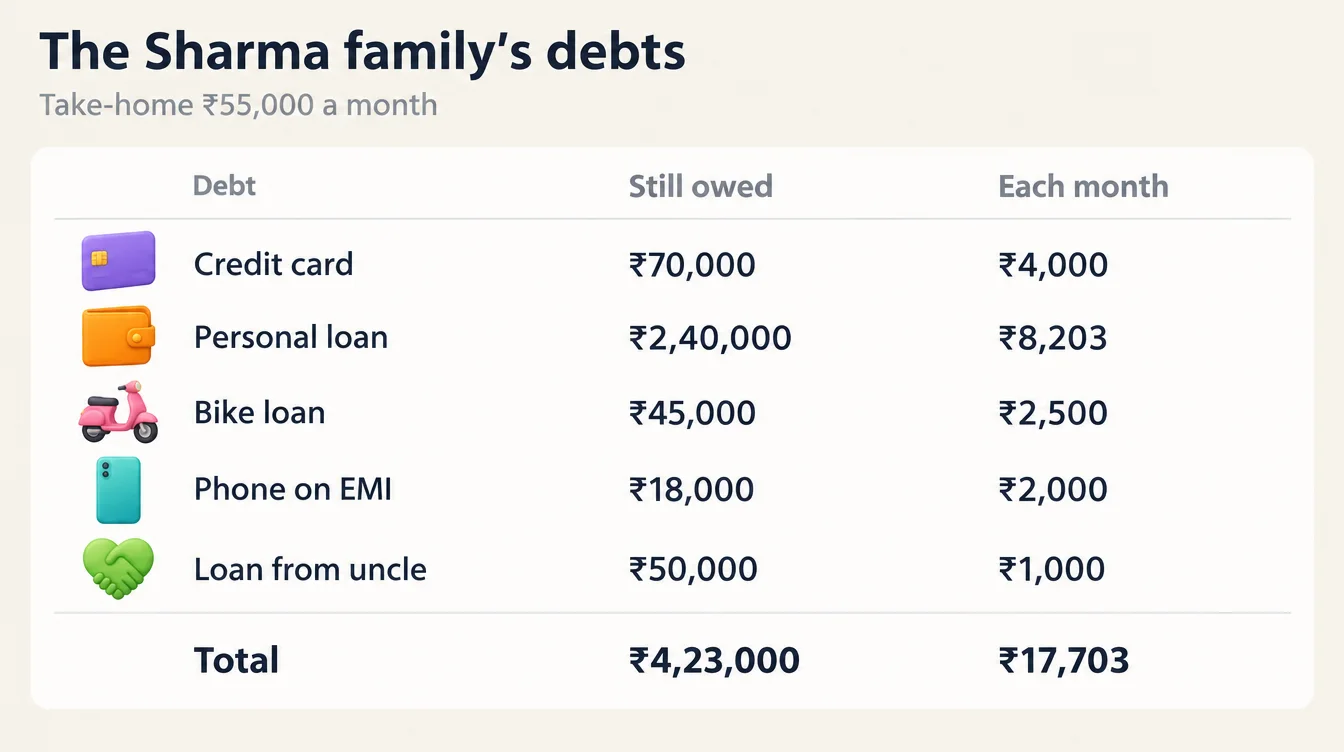
The Sharmas in Lucknow take home ₹55,000 a month. Their debts:
| Debt | Still owed | Interest | Paid each month |
|---|---|---|---|
| Credit card | ₹70,000 | about 42% a year + GST | ₹4,000 |
| Personal loan | ₹2,40,000 | 14% | ₹8,203 |
| Bike loan | ₹45,000 | 10% | ₹2,500 |
| Phone on EMI | ₹18,000 | 0% | ₹2,000 |
| Loan from uncle | ₹50,000 | none | ₹1,000 |
| Total | ₹4,23,000 | ₹17,703 |
That's about 32% of take-home pay, in the stretched zone.
Here's what three different approaches do:
| Plan | Debt-free in | Total interest paid |
|---|---|---|
| Just keep paying as usual | 50 months | about ₹1.16 lakh |
| Roll each closed EMI into the next loan | 30 months | about ₹95,600 |
| Roll over and add ₹6,000 a month, card first | 21 months | about ₹52,800 |
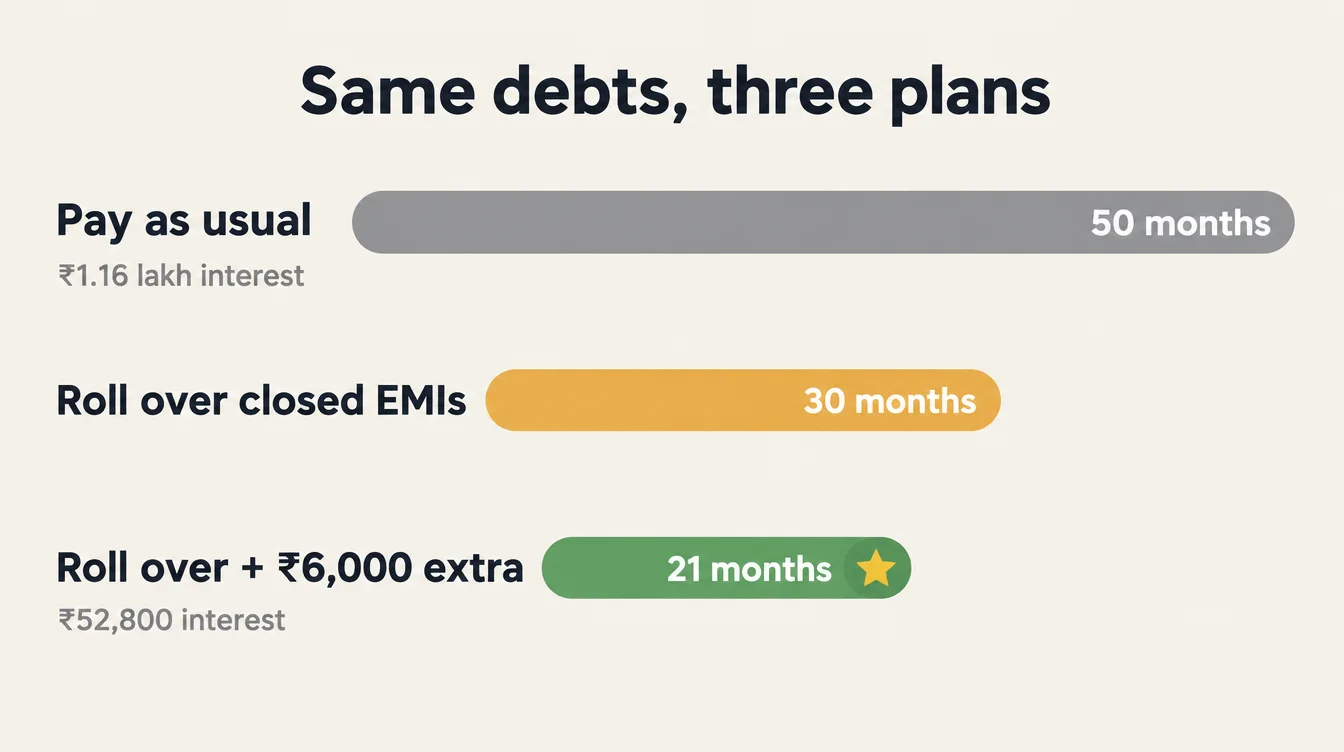
Estimates: interest worked out monthly on each balance; the card at 3.5% a month plus 18% GST on interest; no new borrowing.
With the full plan, the Sharmas clear the credit card in 9 months, the personal loan and bike by month 19, and they're completely debt-free, including their uncle, in 21 months instead of 50. They save about ₹63,000 in interest.
Where does ₹6,000 extra come from? For most families it's a mix: a few cut subscriptions, fewer food deliveries, a festival budget, a part of a bonus, or a small side income. Even ₹2,000 extra helps.
If you can't keep up with your EMIs
If the EMIs are already more than you can pay:
- Talk to your lenders early, before you miss payments. Ask about a longer tenure, a lower EMI for a few months, or restructuring, and how each would show on your credit report.
- Be careful with settlement. It can end the calls, but a "settled" loan can hurt your score for years.
- Know your rights. Recovery agents can't call before 8 am or after 7 pm, threaten you or shame you. See loan recovery agents: your rights.
- Look after yourself. Debt stress is real. You can call Tele-MANAS on 14416, the government's free mental health helpline.
The short version
- List every loan.
- Check your EMI load.
- Stop new debt.
- Build a small buffer.
- Pick one loan to attack first.
- Roll every closed EMI into the next loan.
- Check in every month.
It isn't quick, but it works. Every loan you close is a balloon you let go.
The freeeme app does steps 1, 2, 5 and 6 for you: add your loans once, choose your order, and see the exact month your family will be debt-free, and how much sooner it comes when you pay a little extra.
Questions people ask
What is the fastest way to get out of debt?
Stop taking new loans, keep paying every EMI on time, put any extra money on the most expensive debt first, and when a loan closes, move its EMI to the next one. Even a small extra amount every month shortens the time a lot.
Should I take a new loan to pay off old loans?
Only if the new loan is clearly cheaper, you've compared all fees, and you won't run up the old cards or loans again. A consolidation loan that just moves debt around, or comes from an unknown app, usually makes things worse.
Is debt settlement a good way to get out of debt?
Settlement can end the calls, but the loan is reported as 'settled', which can hurt your credit score for years. Ask your lender about a longer tenure, a lower EMI or a payment plan first, and treat settlement as a last resort.
This is general information to help you understand your options, not financial, legal or tax advice. Rates, rules and charges change; check your lender's latest terms before you decide.