What happens if you miss an EMI? Day by day, and what to do
Missed an EMI? What happens on day 1, day 30 and day 90, what one missed EMI really costs in rupees, and what to do in the first 48 hours.

It happens to more families than you'd think. Salary comes late, a hospital bill arrives, or the money just isn't in the account on the 5th. Missing one EMI is not the end of the world, but it costs money, it shows on your credit report, and it gets worse every week you wait.
Here's exactly what happens if you miss an EMI, day by day, what it costs in rupees, and what to do in the first 48 hours.
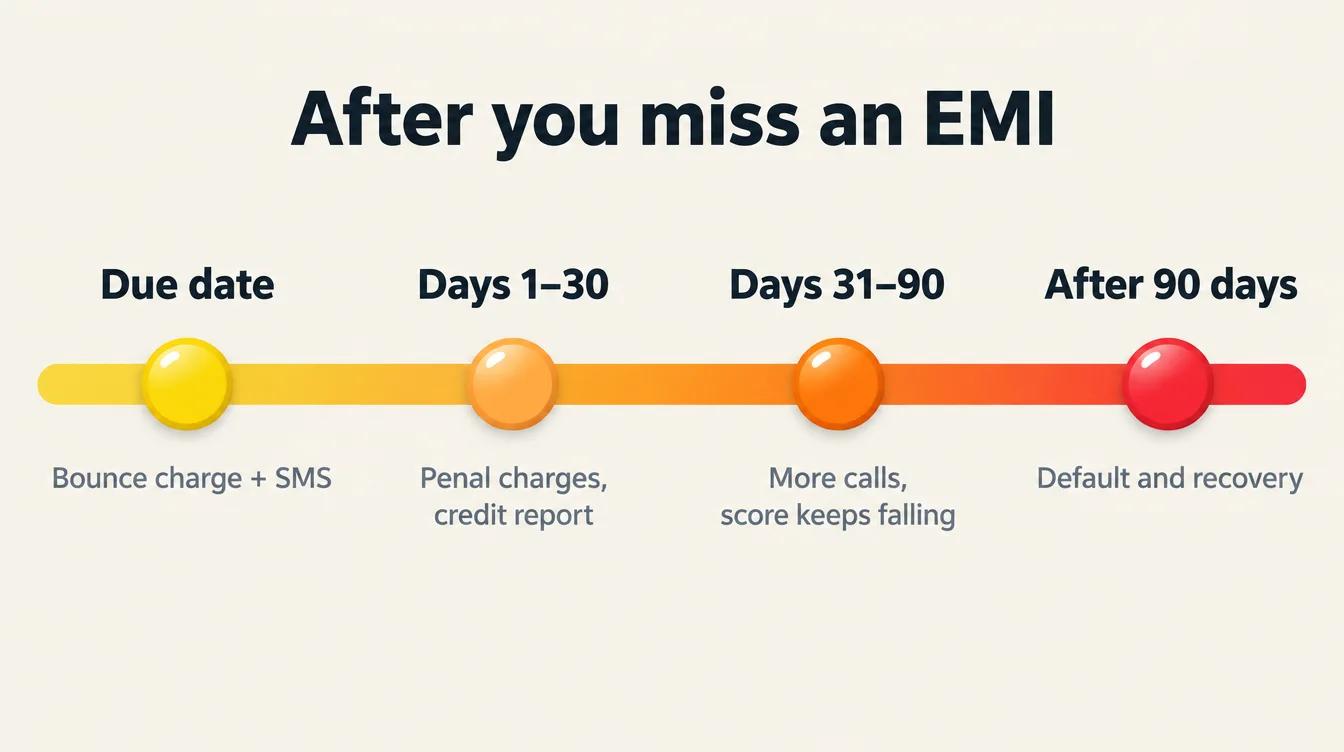
On the due date: the auto-debit bounces
If your EMI is on auto-debit (NACH or ECS) and the money isn't there, the payment fails. You'll usually get an SMS from your lender and from your own bank. Two charges can land at once:
- A bounce charge from your lender for the failed EMI.
- A return charge from your own bank for the failed auto-debit.
Both are set by each bank, are listed in your loan agreement and bank's schedule of charges, and attract 18% GST.
Days 1–30: the loan is overdue
From the day after the due date, your loan is overdue. Lenders call this SMA-0 (up to 30 days late). Three things start happening:
- Penal charges. Your lender can charge a penalty on the overdue amount. Since 2024, RBI rules say this must be a fixed "penal charge", not extra interest, must be "reasonable", must be disclosed in your loan agreement, and can't be compounded.
- Your credit report. Lenders now update credit bureaus every fortnight, so a late EMI can show up on your report within weeks. Your score usually drops.
- Reminder calls and messages from the lender.
Days 31–90: it gets more serious
If the EMI is still unpaid:
- 31–60 days late (SMA-1) and 61–90 days late (SMA-2): more calls, more penal charges, and your credit score keeps falling. If you miss the next EMI too, the overdue amount doubles.
- More than 90 days late: the loan becomes a non-performing asset (NPA), which means it's treated as a default. The lender can start formal recovery. For secured loans, that can mean action on the house, car or gold that backs the loan. A bounced cheque or auto-debit can also lead to a legal notice.
What one missed EMI really costs
Say your EMI is ₹10,000 and you pay it 15 days late. With charges that are common, though they vary by lender:
| Charge | Amount |
|---|---|
| Lender's bounce charge (₹500 + GST) | ₹590 |
| Your bank's auto-debit return charge (₹250 + GST) | ₹295 |
| Penal charge for 15 days (2% a month + GST) | ₹118 |
| Total extra | ₹1,003 |
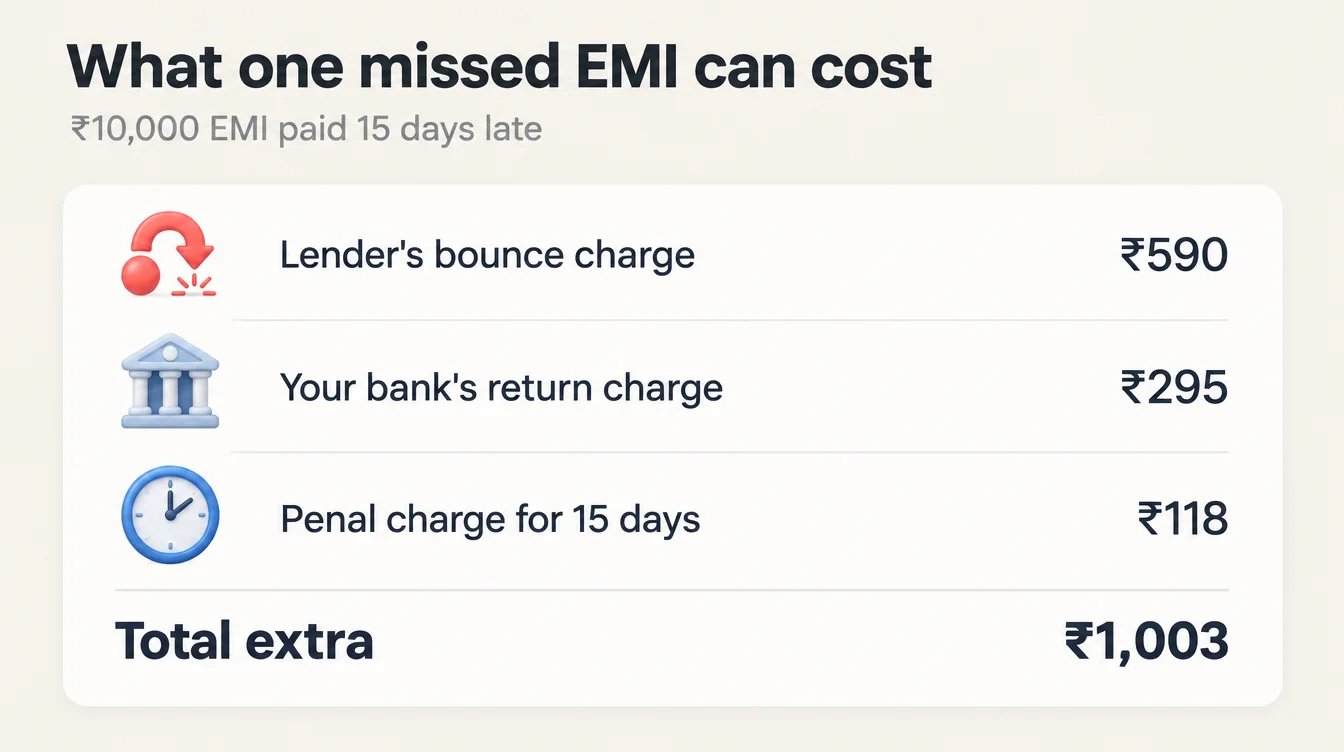
These are example charges; check your own loan agreement and your bank's schedule of charges for the real figures.
That's 10% of the EMI, gone, for a two-week delay, and it doesn't count the hit to your credit score, which can make your next loan costlier.
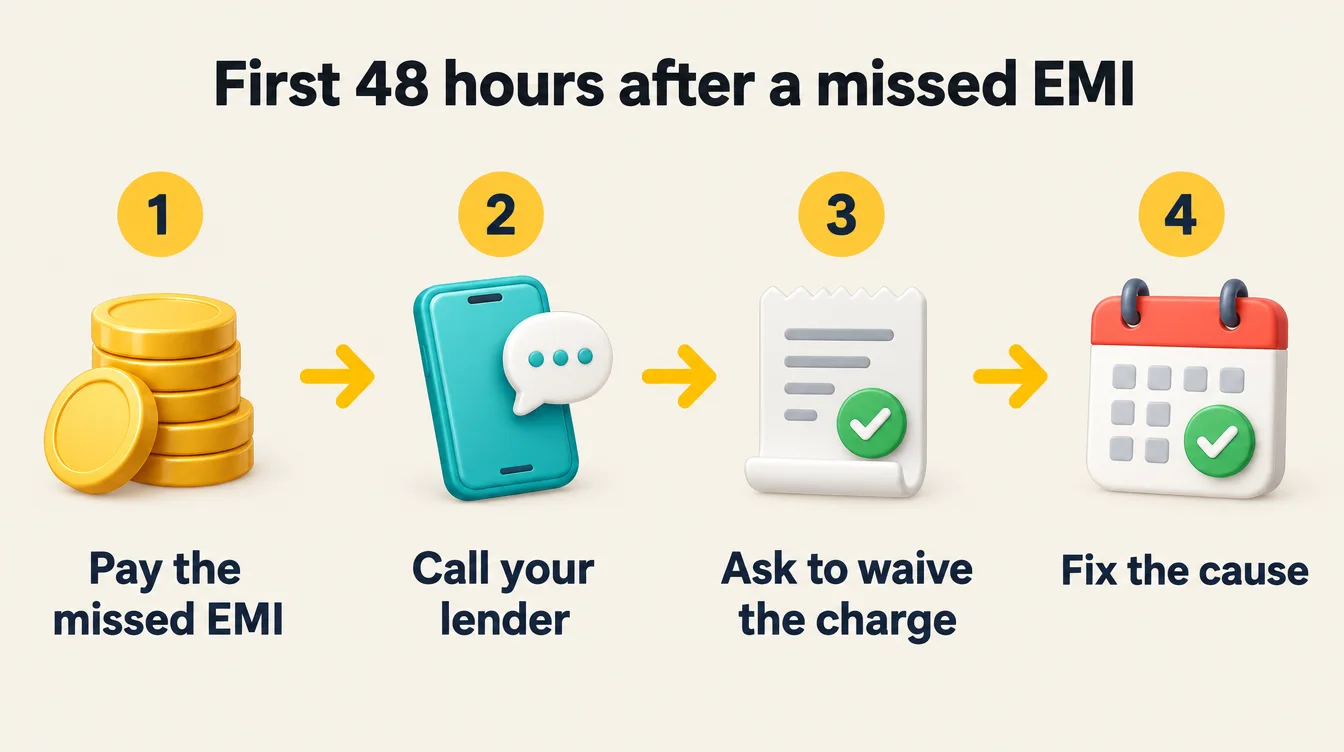
What to do in the first 48 hours
- Pay the missed EMI as soon as you can. Most lenders let you pay overdue EMIs in their app, on their website or at the branch. Paying fast keeps the penal charge small and may keep the delay off your credit report, depending on when the lender reports.
- Call your lender. Tell them what happened and when you'll pay. A borrower who calls first is treated very differently from one who goes quiet.
- Ask for the bounce charge to be waived, if it's your first miss. Many lenders will consider it.
- Fix the cause so it doesn't happen again:
- If salary comes after the EMI date, ask to move the EMI date, or keep the EMI money in a separate account on salary day. Our guide on how to manage multiple EMIs shows how.
- Build a small buffer of one month's EMIs, slowly.
- If you can't pay for several months, ask the lender about options like a longer tenure or a lower EMI for a while, before you miss more payments.
Your rights if recovery calls start
Lenders and their recovery agents must not call before 8 am or after 7 pm, and must not threaten you, use abusive language or shame you in front of family, friends or colleagues. If that happens, complain to the lender in writing, and if it isn't fixed, at cms.rbi.org.in.
If money worries are affecting your sleep or health, you're not alone. You can call Tele-MANAS, the government's free mental health helpline, on 14416.
The short version
- Missing an EMI costs real money: about ₹1,000 on a ₹10,000 EMI for a two-week delay in our example.
- It can show on your credit report within weeks.
- After 90 days, it's treated as a default.
- Pay fast, call your lender, and fix the cause.
The freeeme app reminds you before every EMI, shows all your due dates in one place, and helps you build the small buffer that stops a bad month from becoming a missed EMI.
Questions people ask
Will one missed EMI ruin my credit score?
One missed EMI usually lowers your score, and the late payment shows in your credit report's payment history. If you pay it quickly and every EMI after that on time, its effect fades over time. Several missed EMIs in a row do much more damage.
Can the bank waive the bounce charge?
Sometimes. If it's the first time and you pay quickly, many lenders will consider waiving or reducing a bounce or penal charge if you ask politely. It's their choice, so ask through customer care or your branch.
Can recovery agents call me at any time?
No. Under RBI rules, recovery agents must not call before 8 am or after 7 pm, and must not threaten, abuse or shame you or your family. If they do, complain to the lender in writing, then at cms.rbi.org.in.
This is general information to help you understand your options, not financial, legal or tax advice. Rates, rules and charges change; check your lender's latest terms before you decide.