How does an EMI affect your CIBIL score? Explained simply
How EMIs build or hurt your CIBIL score, what one late payment does, why a lower score can cost lakhs, and how to fix mistakes on your report.

Every EMI you pay leaves a mark on your credit report. Paid on time, EMIs are one of the best ways to build a strong CIBIL score. Paid late, even one EMI can pull it down, and that can make your next loan more expensive.
Here's how it works, in plain words, with what a lower score can cost in rupees.
What your CIBIL score is
Your CIBIL score is a number from 300 to 900 that sums up how you've handled loans and credit cards. Lenders check it before giving you a loan or card, and often to decide your interest rate. Scores of 750 and above are generally seen as very good.
TransUnion CIBIL is the best-known credit bureau in India, but there are others, like Experian, Equifax and CRIF High Mark. Your lenders report to them, and each gives you a score.
How EMIs build your score
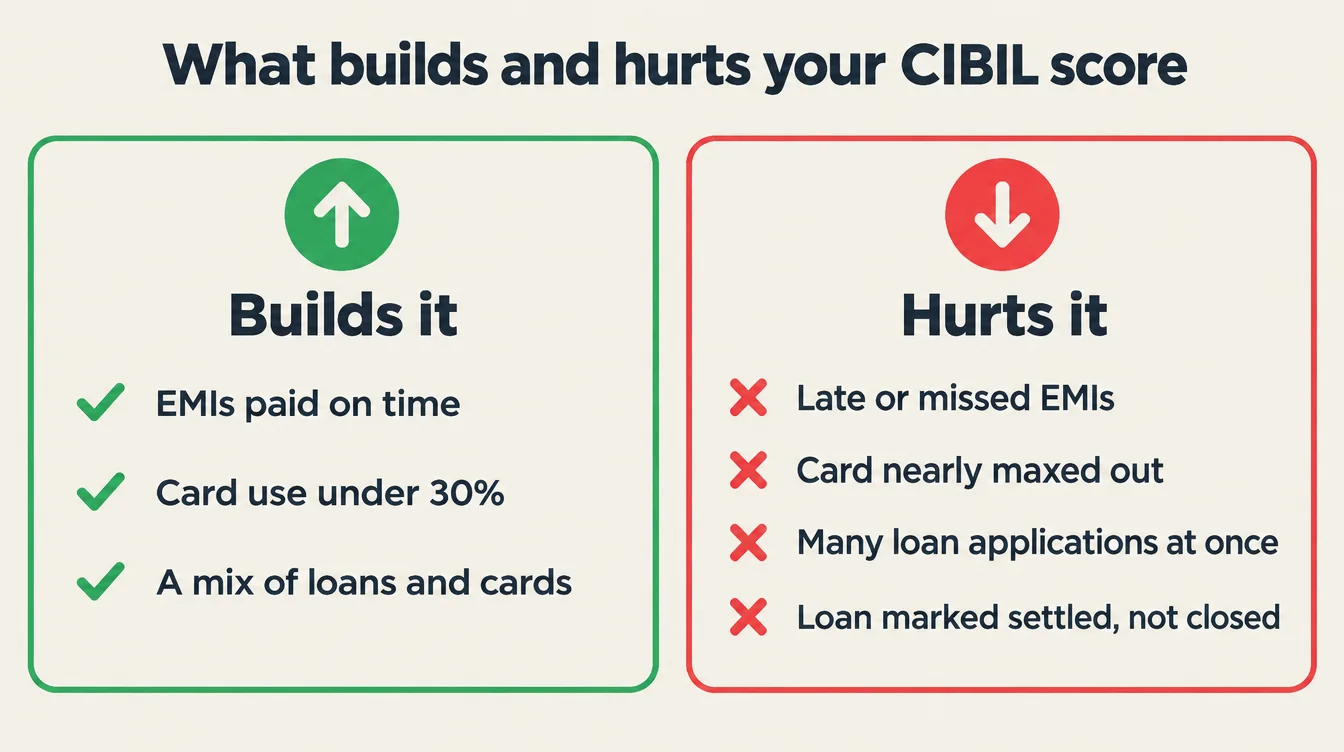
The biggest part of your score is payment history: did you pay what you owed, on time? Every EMI is a monthly test. Pay it on time for months and years, and your report shows a long record of reliability. That's exactly what lenders want to see.
Other things that matter:
- How much of your credit limit you use. On credit cards, using less of your limit is better.
- A mix of credit. A home or vehicle loan alongside a card, handled well, shows you can manage different types.
- How long you've had credit. Older accounts in good standing help.
- How often you apply. Many loan or card applications in a short time can lower your score. Checking your own score doesn't.
What one late EMI does
If an EMI is paid late, your lender reports it as overdue. Since 2025, lenders update credit bureaus every fortnight, so a late payment can appear on your report within weeks.
- A few days late may show as a short delay. It usually lowers the score a little.
- 30, 60 or 90 days late shows as a more serious delay, with a bigger drop.
- More than 90 days late usually means the loan is treated as a default, which does the most damage.
The good news: if you pay quickly and every EMI after that on time, the effect of one late payment fades over time. What happens to your money when an EMI is missed is explained in what happens if you miss an EMI.
Why a lower score can cost lakhs
Lenders often charge a higher interest rate when your score is lower. Here's what a 0.75% difference does to a ₹30 lakh home loan over 20 years:
| Interest rate | EMI | Total interest |
|---|---|---|
| 8.50% | ₹26,035 | about ₹32.5 lakh |
| 9.25% | ₹27,476 | about ₹35.9 lakh |
| Difference | ₹1,441 a month | about ₹3.46 lakh |
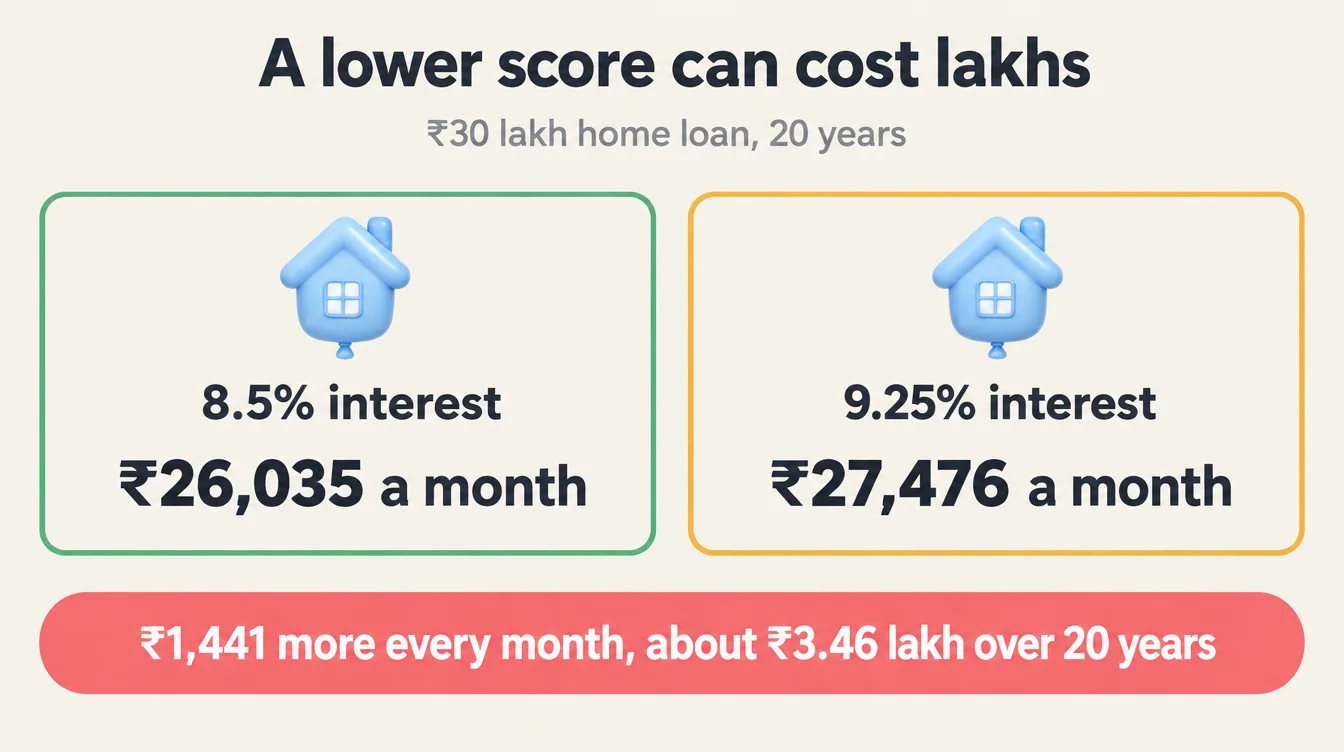
Example rates only. The gap between rates for higher and lower scores varies by lender and loan type.
Over 20 years, that's money that could have gone to school fees, savings or getting debt-free sooner.
Credit cards: keep your usage low
Credit card EMIs and balances count too. One thing many people miss is credit utilisation: how much of your card limit you're using.
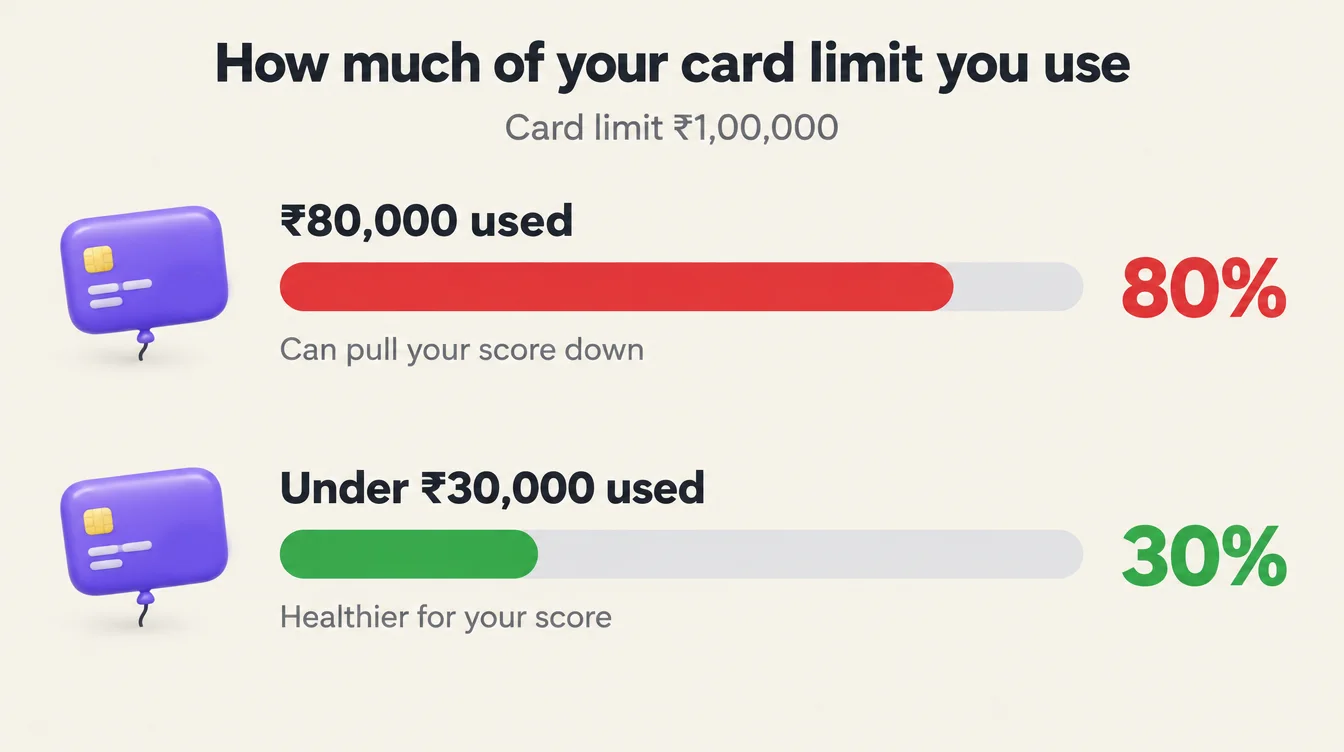
On a card with a ₹1,00,000 limit:
- Using ₹80,000 means 80% utilisation. That can pull your score down, even if you pay on time.
- Keeping it under ₹30,000, or 30%, is a common guideline for a healthier score.
A "no cost EMI" purchase blocks your card limit for the whole EMI period, so it raises your utilisation too, as we explained in Is No cost EMI really free?
Closed vs settled: a big difference
When you finish a loan, check how it's reported:
- Closed: you paid everything you owed. This is good for your record.
- Settled: you and the lender agreed you'd pay less than you owed. It ends the calls, but it can hurt your score for years and make future loans harder to get.
If you're struggling, ask your lender about a longer tenure or lower EMI first. Treat a settlement as a last resort, and understand the credit report impact before you agree.
How to check and fix your report
- Check it once a year, free. By RBI rules, each credit bureau must give you one free full credit report a year. Get it from their official websites.
- Look for mistakes: a loan that isn't yours, a closed loan still shown as open, or a payment marked late that you made on time.
- Raise a dispute with the credit bureau or your lender, with proof such as statements or a no-dues certificate.
- Know your right to compensation. Under RBI rules, if a lender or credit bureau doesn't resolve your complaint within 30 days, you're entitled to ₹100 for every day of delay.
The short version
- On-time EMIs build your score. Late ones hurt it, and lenders now report every two weeks.
- A lower score can cost lakhs in higher interest on your next big loan.
- Keep card usage low, avoid applying for many loans at once, and make sure finished loans say "Closed".
- Check your report once a year, free, and dispute mistakes.
The freeeme app reminds you before every EMI and keeps all your due dates in one place, which is the simplest way to keep your payment history clean.
Questions people ask
Does paying EMIs on time increase my CIBIL score?
Yes. Your payment history is the most important part of your score. Every EMI paid on time adds to a good record, and over months and years that steadily builds a strong score.
How much does one late EMI reduce my CIBIL score?
There's no fixed number. It depends on how late, how much, and the rest of your history. A single late payment usually lowers the score, and it shows in your payment history. Paying quickly and staying on time afterwards helps it recover.
Does closing a loan early improve my score?
Closing a loan in full is good for your record. Make sure the lender reports it as 'Closed', not 'Settled', and get a no-dues certificate. A settled loan, where you paid less than you owed, can hurt your score for years.
This is general information to help you understand your options, not financial, legal or tax advice. Rates, rules and charges change; check your lender's latest terms before you decide.