How to talk to your spouse about debt (without a fight)
Hiding a loan from your husband or wife? A calm, step-by-step way to start the money talk, what to bring, what to say, and how to make one plan together.

In many Indian homes, one person handles the loans and the other doesn't really know. Sometimes that's by habit. Sometimes it's because a credit card balance grew, a personal loan was taken for a family emergency, or money was borrowed from a friend, and it felt easier not to say.
Talking to your spouse about debt is hard. Not talking about it is usually harder. Here's a calm, step-by-step way to start, and how to turn it into one plan you both own.
Why it's worth having the talk
- Hidden loans rarely stay hidden. A recovery call, a bounced EMI or a home loan credit check can bring them out at the worst moment.
- Two people can fix it faster. A shared plan, a little extra from each salary, and fewer surprise expenses can bring the debt-free date much closer.
- It protects the family. If the person managing the loans falls ill or something happens to them, the other needs to know what's owed, to whom, and when.
- Stress shared is stress halved. Carrying a money secret alone affects sleep, health and the relationship itself.
Step 1: Get your facts ready first
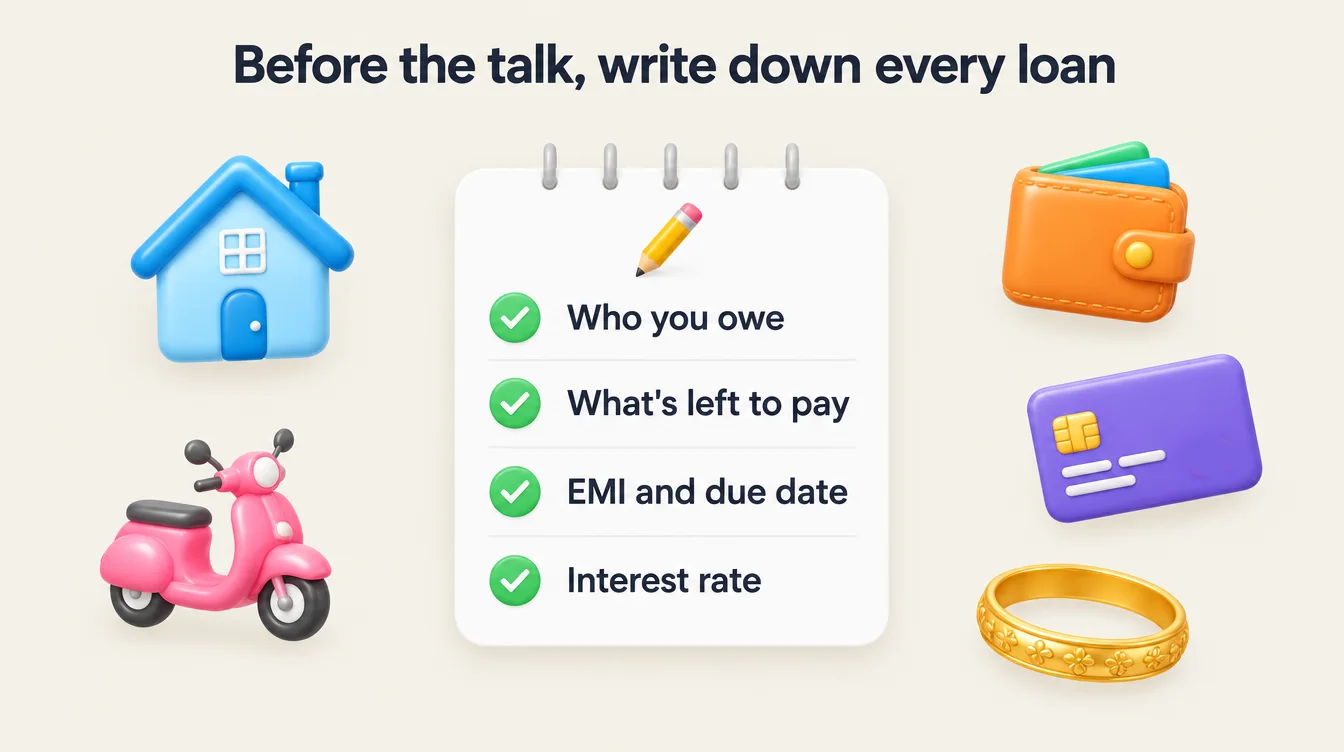
Before you talk, write down every loan you have. For each one, note:
- The lender, or the person you borrowed from
- What's left to pay
- The EMI and its due date
- The interest rate, if you know it
Include credit cards, pay-later, phone EMIs, gold loans and money from family or friends. Our guide on how to manage multiple EMIs has a simple way to list them.
Walking in with a clear list shows you're taking it seriously, and it keeps the talk about facts, not guesses.
Step 2: Pick a calm time and place
- Not during a fight, late at night, in front of children or relatives, or right after a bill arrives.
- Do choose a quiet time when you're both rested, like a weekend morning.
- Say it upfront: "I want to talk about our money. It's important, and I'd like us to sort it out together."
Step 3: Start with honesty, not excuses
Lead with the truth, then the reason, then what you want:
"There's something I should have told you earlier. I have a credit card balance of ₹40,000 and a personal loan I took last year. I didn't tell you because I was embarrassed. I want us to look at it together and make a plan."
What helps:
- Take responsibility, even if there were good reasons for the loan.
- Use "I" and "we", not "you": "I'm worried", "we can fix this".
- Give the full picture at once. Revealing loans one by one over weeks hurts trust more.
What to avoid:
- Blaming your spouse, parents or "circumstances".
- Saying "it's nothing" when it's clearly something.
- Promising "it'll never happen again" before there's a plan.
Step 4: Listen, and let them react
Your spouse may feel shocked, hurt or angry, especially if they're hearing about a loan for the first time. That's normal.
- Let them ask questions, and answer honestly.
- If it gets heated, it's fine to say: "Let's take a break and talk again tomorrow."
- If they have loans you didn't know about, listen the same way you'd want to be heard.
The first talk is about honesty. The plan can come next.
Step 5: Put everything on one list, together
Now combine both partners' loans in one place. Take Arjun and Divya, who take home ₹90,000 a month together:
| Loan | Whose | Monthly EMI |
|---|---|---|
| Home loan | Joint | ₹22,000 |
| Personal loan | Arjun | ₹8,000 |
| Scooter loan | Divya | ₹3,000 |
| Credit card balance of ₹40,000 | Arjun | no fixed EMI |
| Gold loan of ₹60,000 | Divya | interest only |
| Total EMIs | ₹33,000 |
That's about 37% of their take-home pay on EMIs, in the stretched zone, before counting the card and gold loan. The card alone is costing about ₹1,650 a month in interest and GST at a typical 3.5% a month, if it isn't paid off.
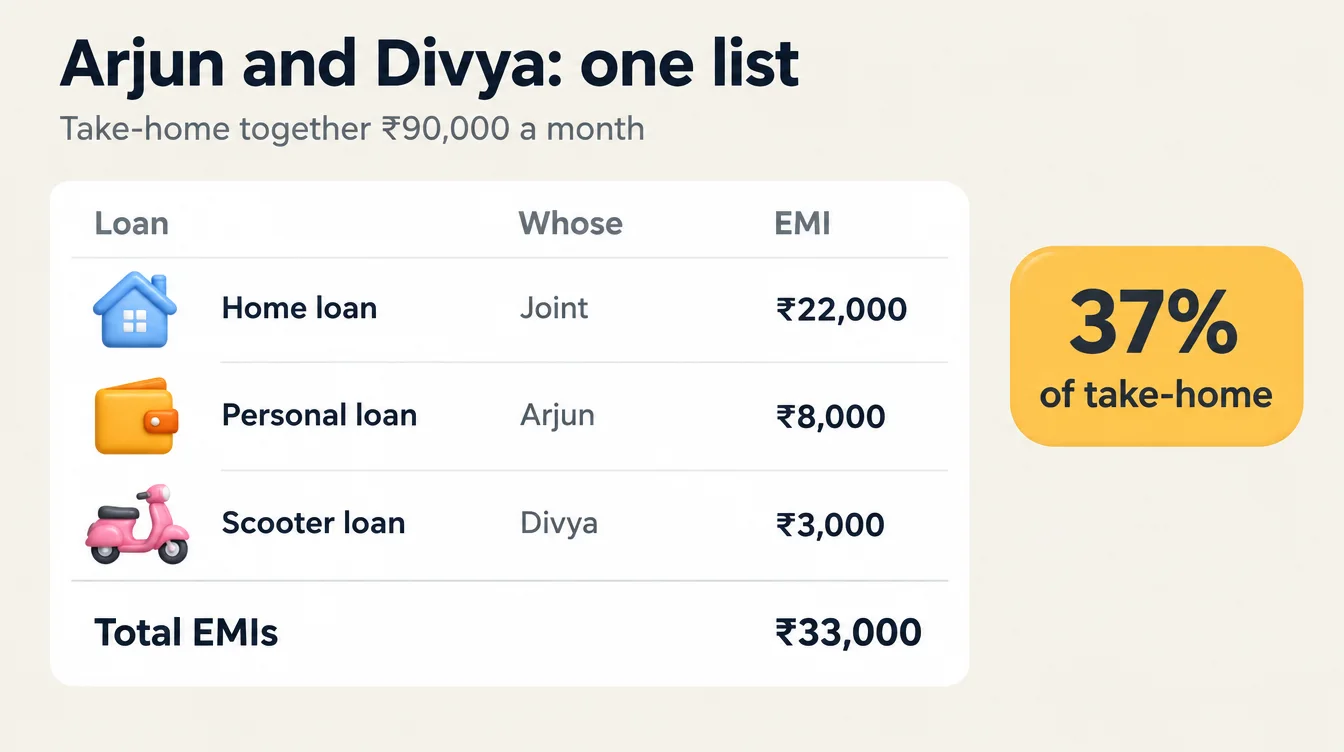
Seeing it together turns "your loan" and "my loan" into our plan.
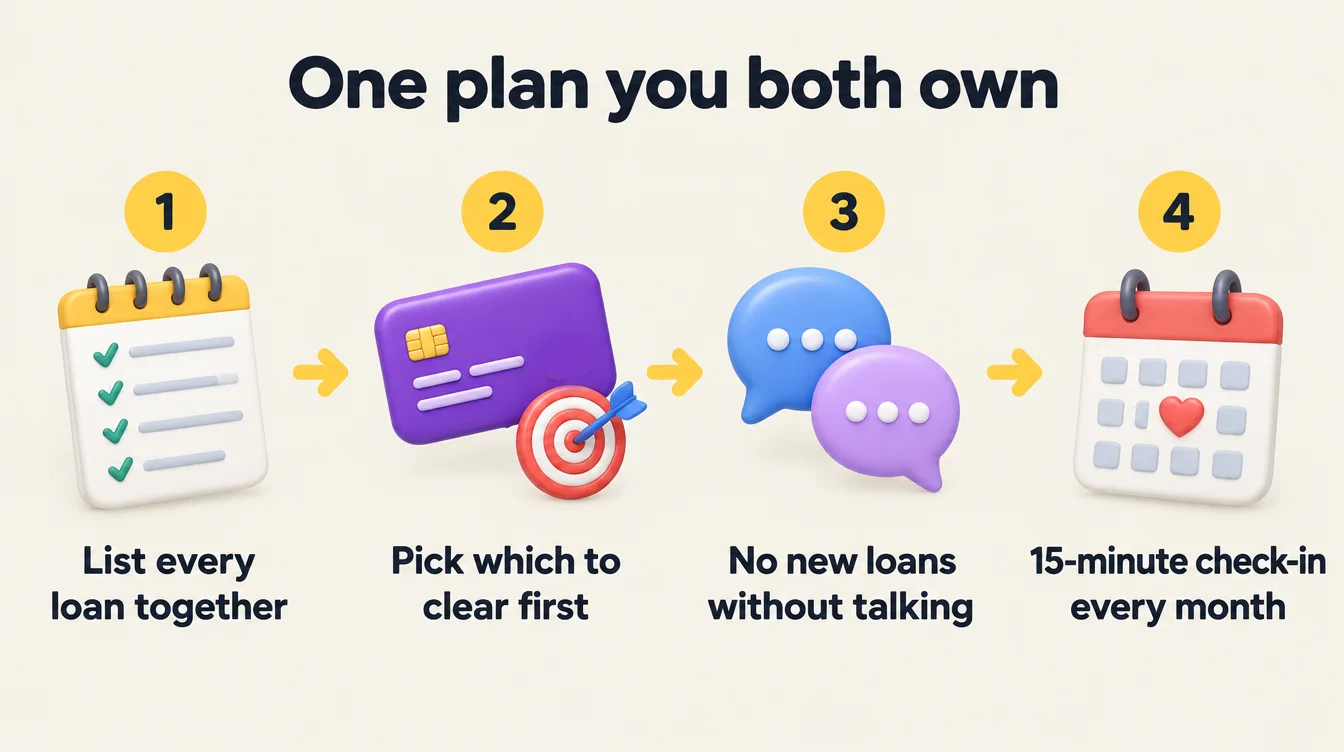
Step 6: Agree on a plan you both own
- Which loan first? Usually the most expensive one, like the credit card. See debt snowball vs avalanche.
- How much extra each month? Agree on an amount, even ₹2,000, and where it comes from.
- No new loans without talking first. Including phones on EMI and pay-later.
- A monthly 15-minute check-in. Same day each month, to tick off EMIs and see progress.
- Both know the essentials: lenders, due dates, and where the papers are.
If the talk doesn't go well
Not every first conversation ends well. Give it a day or two, then try again. If money keeps causing fights, it can help to talk it through with a trusted elder, a family friend or a counsellor.
If debt stress is affecting your health or relationship, you can call Tele-MANAS on 14416, the government's free mental health helpline.
The short version
- Write down every loan first.
- Pick a calm time and start with honesty.
- Listen, and let them react.
- Put both partners' loans on one list.
- Agree a plan together, and check in every month.
freeeme is built for exactly this: a family plan where each person chooses which loans to share, everyone sees the same debt-free date, and you work towards it together.
Questions people ask
Should I tell my spouse about my debt?
In most families, yes. Hidden loans tend to come out anyway, through a recovery call, a bounced EMI or a credit check for a home loan, and finding out that way usually hurts more than being told. Telling them early also means two people can work on the plan.
What if my spouse gets angry?
Some anger or hurt is normal at first. Say what happened, take responsibility, and suggest pausing and coming back to it the next day if the talk gets heated. The goal of the first talk is honesty, not solving everything.
Do we have to share every loan?
Every family decides for itself. But both partners knowing the total EMIs and the main loans makes planning far easier, and protects the family if something happens to the person who manages the money.
This is general information to help you understand your options, not financial, legal or tax advice. Rates, rules and charges change; check your lender's latest terms before you decide.