Credit card minimum due: what happens if you pay only that
Paying only the minimum due keeps your card in good standing, but a ₹50,000 balance could take 16 years to clear. Here's why, and how to get out.

Your credit card bill says Total due: ₹50,000. Minimum due: ₹2,603. Paying the smaller number feels responsible. The card stays active, there's no late fee, and the bank seems happy.
The bank is happy. Paying only the minimum due is the most expensive way to use a credit card. The RBI even makes banks print a warning on every statement that "making only the minimum payment every month would result in the repayment stretching over months/years". Here's what that looks like in rupees.
What the minimum due really is
The minimum due is the smallest amount you must pay to avoid a late fee. It's usually around 5% of what you owe, plus any EMIs and fees on the card. It varies by bank, so check your statement.
Paying it keeps your card in good standing. But it doesn't stop interest. Interest is charged on everything you didn't pay, usually at 3–3.75% a month, which is about 36–45% a year, plus 18% GST on that interest.
Where your minimum payment goes
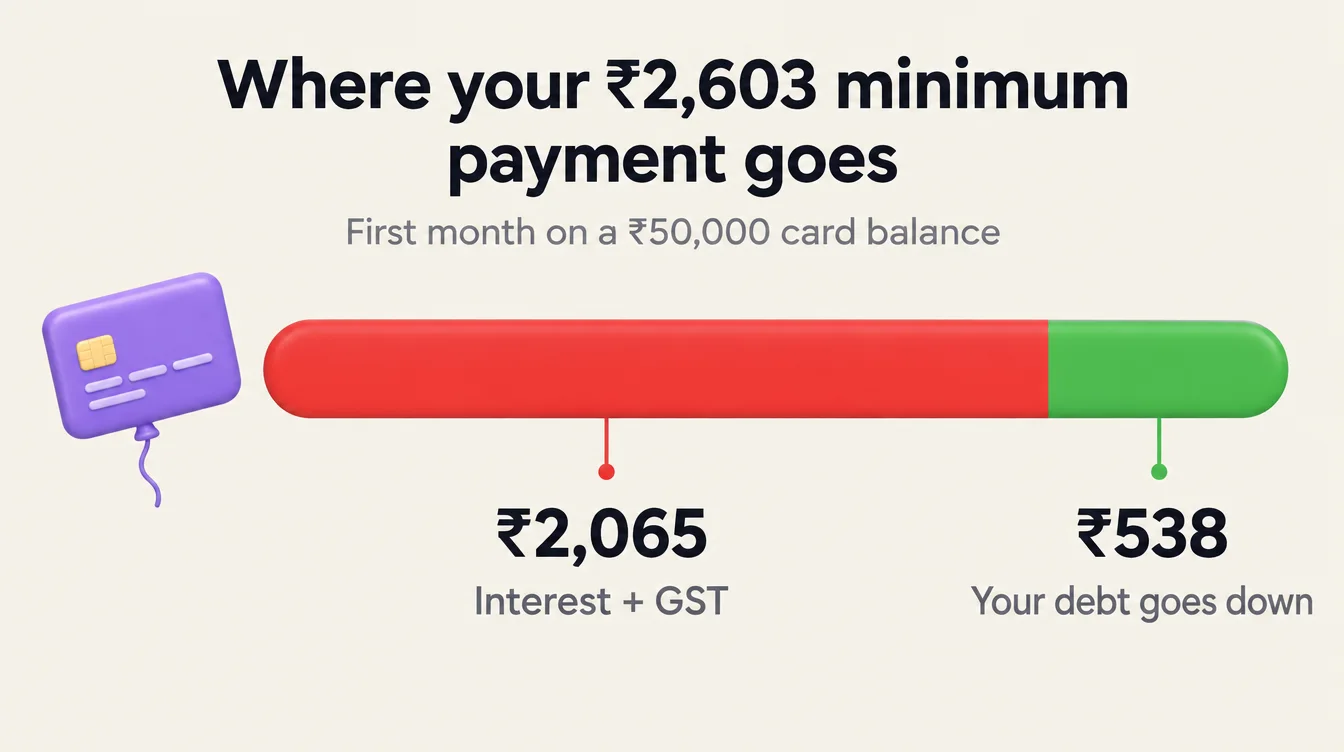
Take a ₹50,000 balance at 3.5% a month. In the first month:
- Interest: ₹1,750
- GST on that interest: ₹315
- Minimum due (5%): about ₹2,603
So of your ₹2,603, ₹2,065 goes to interest and GST. Only ₹538 actually reduces your debt.
How long it takes, in rupees
Here's the same ₹50,000 card, with no new spending, under two plans:
| Plan | Time to clear | Interest + GST | Total you pay |
|---|---|---|---|
| Pay only the minimum due | about 16 years | about ₹1.65 lakh | about ₹2.15 lakh |
| Pay ₹5,000 every month | 14 months | about ₹15,800 | about ₹65,800 |
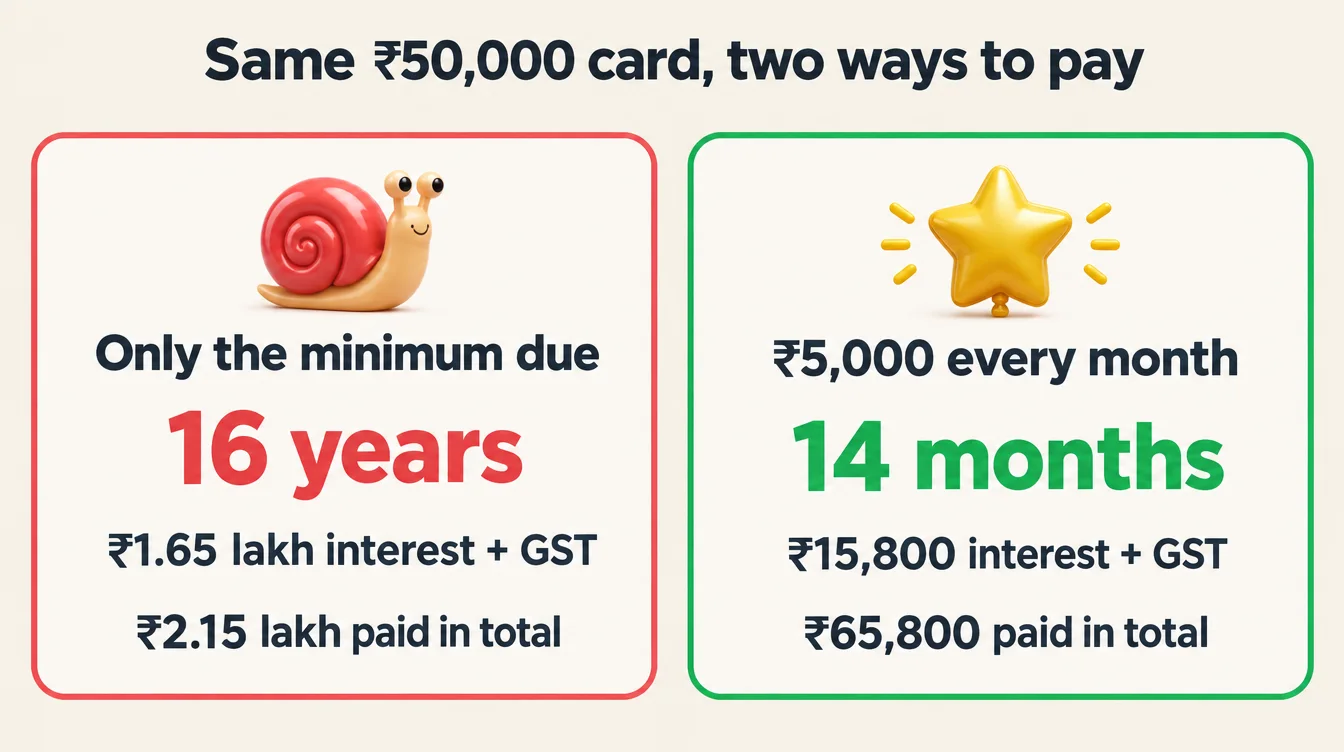
Estimates: we assumed 3.5% interest a month, 18% GST on interest, a minimum due of 5% of the balance (at least ₹500), and no new purchases. Your bank's numbers will differ a little.
Paying only the minimum, you'd pay back more than four times what you borrowed, and still be paying off a Diwali shopping bill from 2026 in the 2040s.
Two more catches
1. You lose the interest-free period. Normally, new purchases are interest-free until your due date. But when part of last month's bill is unpaid, most banks stop the interest-free period. Every new purchase, even a ₹200 grocery bill, starts charging interest from day one.
2. Your credit score can slip. A card that's nearly full raises your credit utilisation, the share of your limit you're using. That can pull your score down, even if you never miss a payment.
New from 1 November 2026: higher fees on some cards
Card fees are going up at some banks. For example, Punjab National Bank's Visa and RuPay credit cards change from 1 November 2026:
- Late fee: none up to ₹500 due, then ₹500, ₹750, ₹1,000 or ₹1,200 depending on the amount due (₹1,000 for ₹10,001–₹50,000)
- Failed auto-debit or cheque: 2% of the amount, at least ₹400
- Cash withdrawal: 2.5% or ₹400, whichever is higher
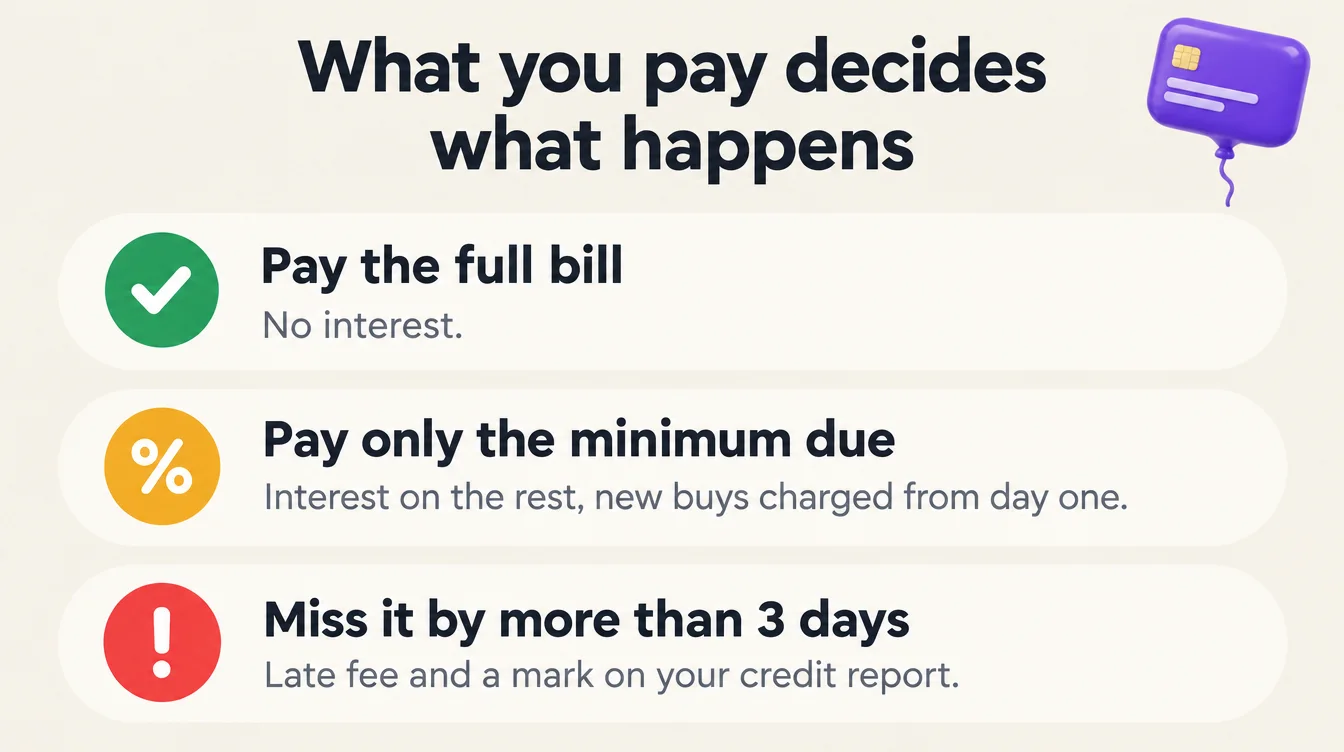
Under RBI rules, a late fee can only be charged, and the card reported as past due to credit bureaus, once a payment is more than three days late. Fee changes like these are announced by email or SMS, so check your bank's messages this month.
How to get out of the minimum due trap
- Stop new spending on that card until it's cleared. Use UPI or a debit card for daily spending.
- Pick a fixed amount you can pay every month, and stick to it even as the minimum due falls. Paying the first month's minimum (₹2,603) every month, instead of a falling 5%, clears the ₹50,000 in a little over 3 years instead of 16.
- Ask your bank about converting the balance to an EMI. The interest is usually much lower than 3.5% a month. Compare the processing fee and GST, as we explained in our No cost EMI guide.
- If you have several cards or loans, pay the most expensive one first. Card debt at 42% is usually the most expensive, as we showed in debt snowball vs avalanche.
- Talk to your bank before you miss a payment. Ask what options they have, such as a payment plan.
The freeeme app shows what each card is really costing you, and the month you'll be free of it if you pay a fixed amount instead of the minimum.
Questions people ask
Is paying the minimum due bad for my credit score?
Paying at least the minimum due by the due date means the payment isn't late, so it isn't reported as missed. But a high unpaid balance keeps your credit utilisation high, which can lower your score over time.
Do I pay interest on new purchases if I paid the minimum due?
Usually yes. If any part of last month's bill is unpaid, most cards stop the interest-free period, so new purchases start attracting interest from the day you make them until the whole balance is cleared.
What happens if I miss even the minimum due?
Under RBI rules, a card can be charged a late fee and reported as past due to credit bureaus once it is more than three days past the due date. Interest and GST continue on the full balance.
This is general information to help you understand your options, not financial, legal or tax advice. Rates, rules and charges change; check your lender's latest terms before you decide.