How to manage multiple EMIs: a simple system for Indian families
Five EMIs, different dates, one salary. A simple four-step system to see every loan, stop missing due dates and start getting debt-free.

Home loan on the 5th. Personal loan on the 10th. The scooter on the 15th, the phone on the 20th, a credit card EMI on the 25th. And money from your brother that nobody has written down. If you're juggling multiple EMIs, the problem usually isn't one loan. It's that nobody in the house can see all of them at once.
Here's a simple four-step system to manage multiple EMIs, with a worked example in rupees.
First, check how heavy your EMI load is
Add up every EMI you pay in a month and divide it by your take-home pay, the amount that actually reaches your bank account.
- Under 30%: comfortable. You have room for surprises.
- 30–50%: stretched. One hospital bill or late salary can cause a missed EMI.
- Over 50%: high risk. More than half your income is gone before the month starts.

These bands are a rule of thumb, not a law. Many lenders get cautious about new loans when EMIs pass roughly 40–50% of income, so this number also tells you how much room you really have.
Meet the Rao family
The Raos in Chennai bring home ₹75,000 a month. Salary arrives on the 1st. Their EMIs:
| Loan | EMI | Due on |
|---|---|---|
| Home loan | ₹18,000 | 5th |
| Personal loan | ₹7,000 | 10th |
| Two-wheeler loan | ₹2,800 | 15th |
| Phone on EMI | ₹2,200 | 20th |
| Credit card EMI | ₹4,000 | 25th |
| Total | ₹34,000 |
₹34,000 out of ₹75,000 is about 45%. They're in the stretched zone, close to the edge. They also owe ₹50,000 to a brother, with no fixed date.
Step 1: Put every loan on one list
You can't manage what you can't see. Write down every loan, including the ones that feel too small or too personal to count:
- Bank and NBFC loans, gold loans, and credit card EMIs
- Phones, TVs and appliances bought on EMI, and pay-later balances
- Money borrowed from family or friends, and chit fund instalments
For each one, note what's left to pay, the EMI, the due date and the interest rate. For family loans, write down what you owe even if there's no date.
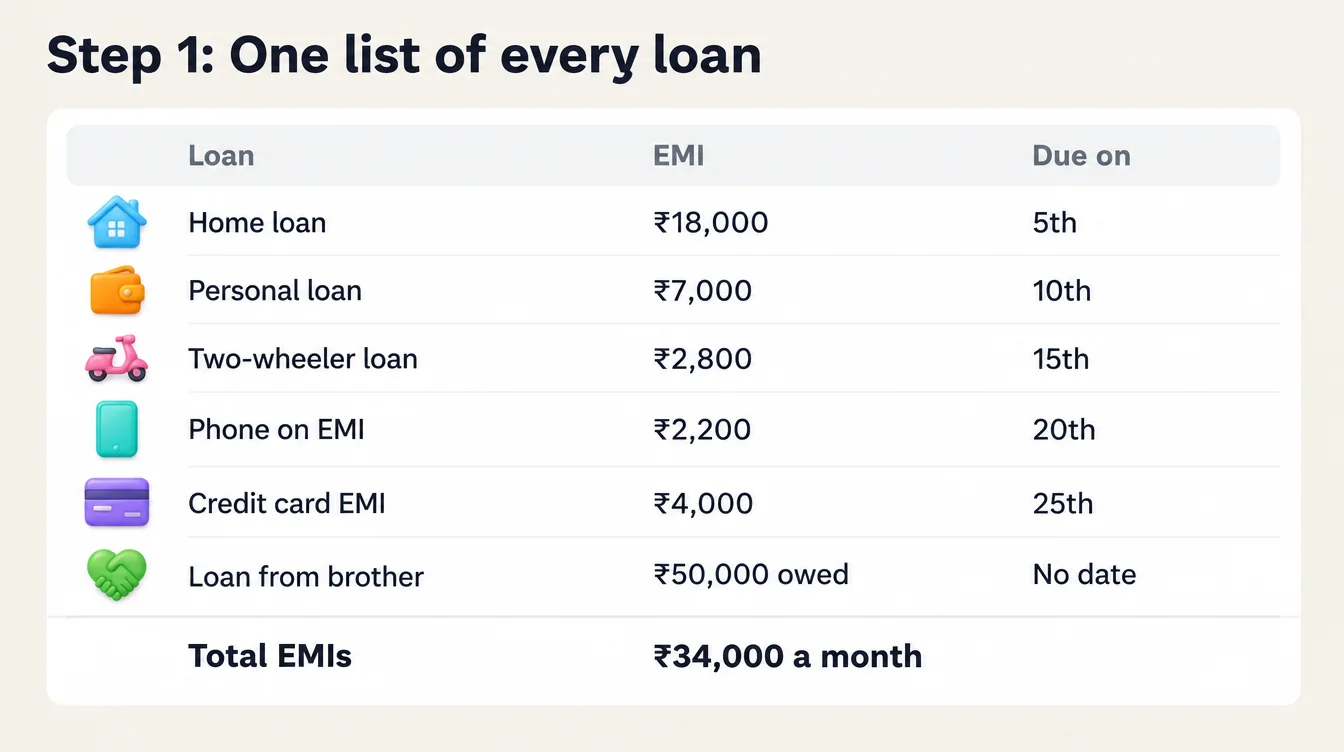
Do this together as a family. In many homes, one person pays the EMIs and others don't know the full picture, which is exactly how a due date gets missed.
Step 2: Line up due dates with salary day
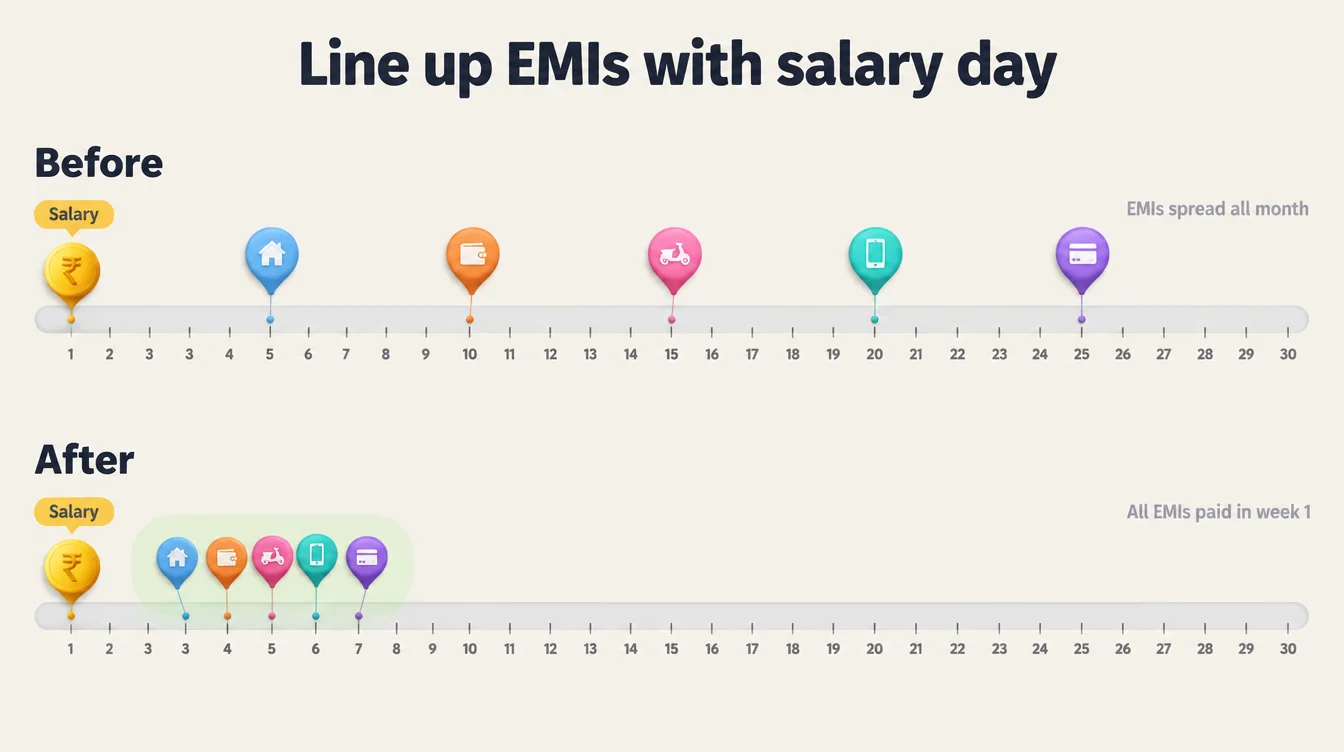
The Raos' salary arrives on the 1st, but the last EMI leaves on the 25th. By then, the month's spending has already eaten into the money. That's when an auto-debit bounces and a bounce charge or late fee lands, on top of a mark on the credit report.
The fix is to pay every EMI in the first week after salary:
- Ask each lender if you can move the EMI date. Many allow it, sometimes for a small fee.
- Where you can't move the date, set aside that EMI's money on salary day in a separate account or "jar", so it's not spent.
- Keep one account just for EMIs, with auto-debits from it, and move the total in on salary day.
Step 3: Build a small EMI buffer
One late salary or surprise expense shouldn't cause a missed EMI. Aim for a buffer equal to one month of EMIs. For the Raos, that's ₹34,000.
That sounds like a lot, so build it slowly. ₹3,000 a month gets them there in about a year. Keep it in a separate savings account and use it only to stop an EMI from bouncing.
Step 4: Close loans in an order, and roll the EMI over
Now decide which loan to attack first with any extra money. There are two good methods, explained with full numbers in Debt snowball vs avalanche: which loan to pay off first.
The most important habit: when a loan closes, move its EMI to the next loan instead of spending it.
For the Raos, the phone EMI ends in 4 months and the credit card EMI in 6. After that, their EMIs fall from ₹34,000 to ₹27,800, about 37% of take-home pay. That's still in the stretched zone, but well away from the edge. If they put that freed ₹6,200 towards the personal loan, it closes much sooner too.
If you're already missing EMIs
Talk to your lender before you miss a payment, not after. Ask what options they have, such as a longer tenure or a lower EMI for a few months. Restructuring can lower the EMI, but usually means paying more interest in total, and it may be noted on your credit report, so ask about both.
If a recovery agent ever threatens or harasses you, that's against RBI rules. You can complain to the lender and then at cms.rbi.org.in.
Your one-page plan
- List every loan, including family loans.
- Work out your EMI load as a share of take-home pay.
- Pay every EMI in the week after salary day.
- Build a buffer of one month's EMIs, slowly.
- Close loans in order, and roll each freed EMI into the next.
The freeeme app does the list and the maths for you: add each loan once, see every due date in one place, and find the month your family will be debt-free.
Questions people ask
How many EMIs is too many?
It's less about the number of loans and more about the share of your take-home pay they take. If all your EMIs add up to more than about half of what reaches your bank account each month, one bad month can lead to a missed payment.
Can I change the date my EMI is debited?
Many lenders let you request a new EMI date, sometimes for a small fee or with one month of extra interest. Ask your lender's customer care or branch what they allow before you set up a new auto-debit.
Should I take one big loan to close all the small ones?
A consolidation loan only helps if its interest rate is clearly lower than the loans it replaces and you don't take new loans afterwards. Compare the total cost, including processing and foreclosure charges, before you decide.
This is general information to help you understand your options, not financial, legal or tax advice. Rates, rules and charges change; check your lender's latest terms before you decide.