How much EMI can I afford on my salary? A simple rule
A simple rule for how much EMI your salary can handle, with a ₹ table for ₹30,000 to ₹1 lakh take-home and the loan size each EMI buys.

Festive season is when many families buy a car, a bike, gold or a new phone on EMI. The bank or showroom will tell you how much you can borrow. The question that matters is different: how much EMI can your family comfortably pay every month, for years?
Here's a simple rule, a ₹ table by salary, and a worked example.
The simple rule: keep all EMIs under 30% of take-home pay
Add up every EMI you'll be paying, including the new one, and compare it with your take-home pay, the amount that reaches your bank account each month.
- Under 30%: comfortable. Room for rent, food, school fees, savings and surprises.
- 30–50%: stretched. Manageable only if your income is steady and you have a buffer of at least one month's EMIs. Try not to go above 40%.
- Above 50%: high risk. One late salary or hospital bill can mean a missed EMI.
This matches the EMI load bands in our guide to managing multiple EMIs.
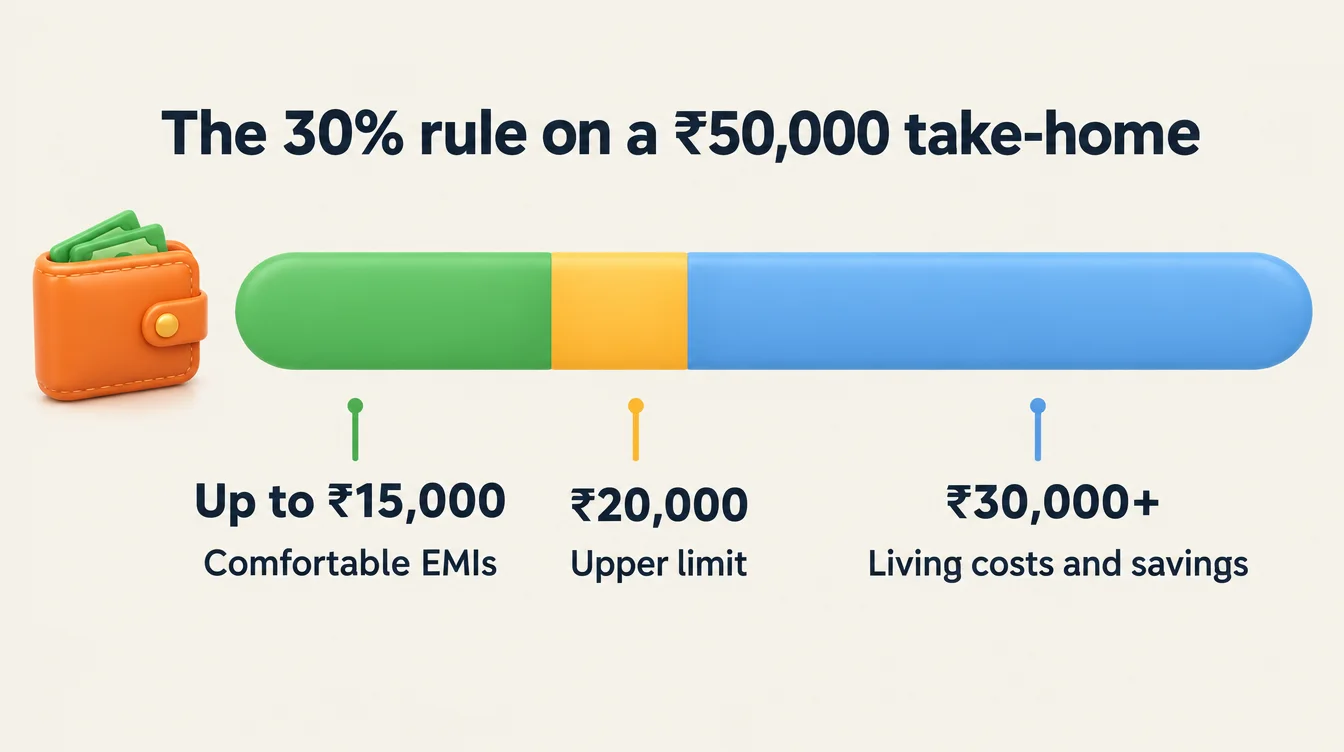
Why take-home and not gross salary? Because tax, PF and other deductions never reach you. Your EMIs are paid from what's left.
How much EMI your salary can handle
If you have no other EMIs, here's what 30% and 40% look like, and roughly how big a loan a 30% EMI could pay off:
| Take-home pay | Comfortable EMI (30%) | Upper limit (40%) | Home loan (20 yrs) | Car loan (5 yrs) | Personal loan (3 yrs) |
|---|---|---|---|---|---|
| ₹30,000 | ₹9,000 | ₹12,000 | about ₹10.4 lakh | about ₹4.3 lakh | about ₹2.7 lakh |
| ₹50,000 | ₹15,000 | ₹20,000 | about ₹17.3 lakh | about ₹7.1 lakh | about ₹4.5 lakh |
| ₹75,000 | ₹22,500 | ₹30,000 | about ₹25.9 lakh | about ₹10.7 lakh | about ₹6.7 lakh |
| ₹1,00,000 | ₹30,000 | ₹40,000 | about ₹34.6 lakh | about ₹14.3 lakh | about ₹8.9 lakh |
Loan sizes use example rates of 8.5% for a home loan, 9.5% for a car loan and 13% for a personal loan. Your rate depends on the lender and your credit score.
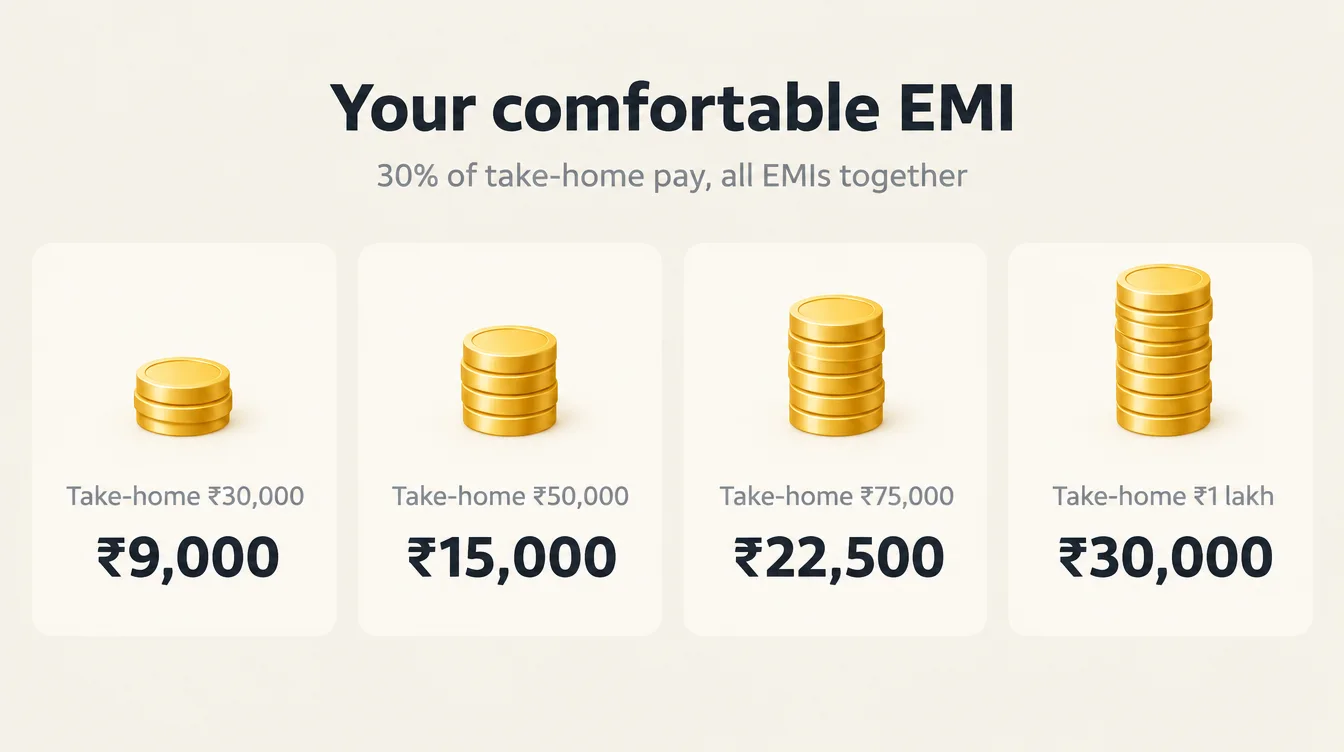
If you already pay EMIs, subtract them first. The table shows your whole EMI budget, not the budget for one new loan.
A worked example: Meena wants a car this Dhanteras
Meena takes home ₹50,000 a month. She already pays ₹4,000 in EMIs (₹1,500 for a phone and ₹2,500 for a scooter).
- Her comfortable EMI budget is 30% of ₹50,000 = ₹15,000.
- Minus existing EMIs: ₹15,000 − ₹4,000 = ₹11,000 room for a new EMI.
- At 9.5% over 5 years, ₹11,000 a month pays off a car loan of about ₹5.2 lakh.
The showroom offers her two options:
| Car loan | New EMI | All EMIs | Share of take-home |
|---|---|---|---|
| ₹5 lakh | ₹10,501 | ₹14,501 | 29% (comfortable) |
| ₹8 lakh | ₹16,801 | ₹20,801 | 42% (stretched) |
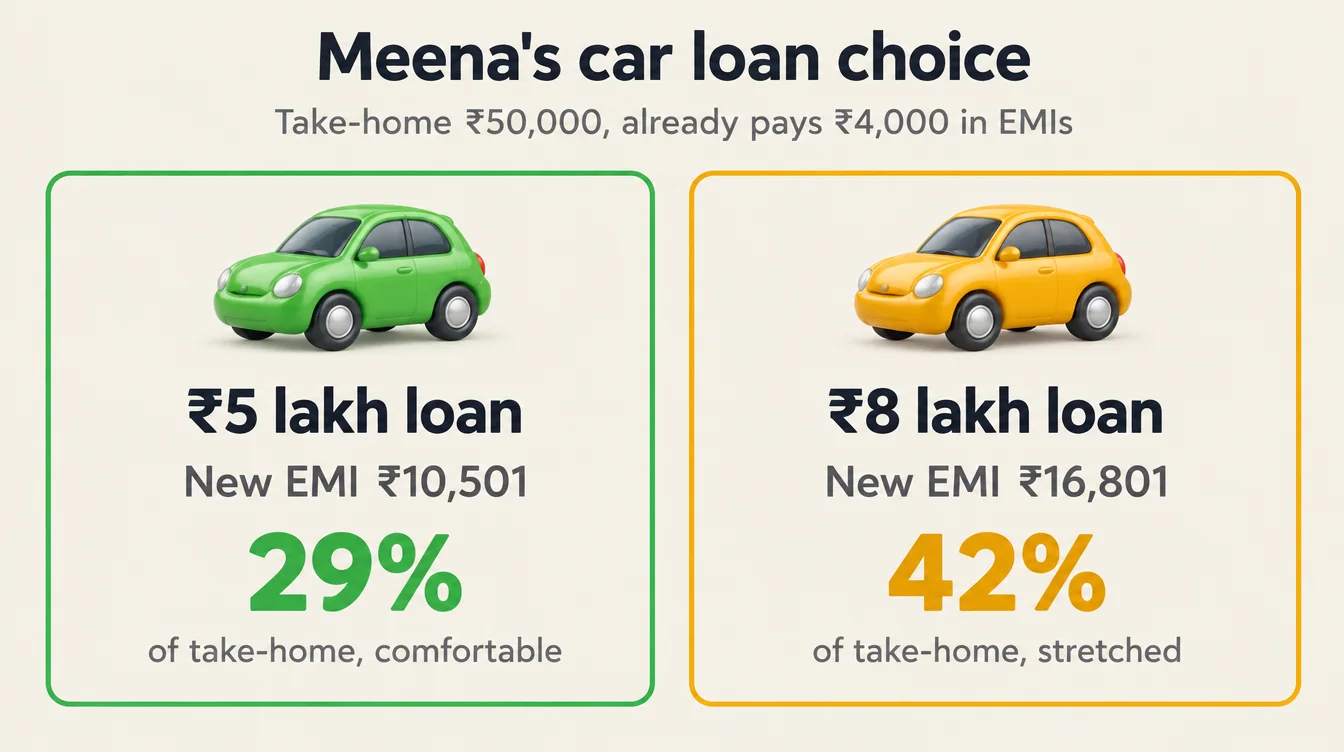
The ₹8 lakh loan might still be approved, but it would leave Meena with very little room for anything going wrong. A bigger down payment, a cheaper model, or waiting until her phone EMI ends would keep her in the comfortable zone.
Before you sign, check these four things
- Count every EMI, including small ones like phones, appliances and pay-later. They add up fast, as we showed in the No cost EMI guide.
- Plan for rate rises. If it's a floating-rate loan, a higher rate can make the loan longer or the EMI bigger, as happened after the October 2026 rate hike.
- Keep a buffer of at least one month's EMIs in savings before you take the loan.
- Ask "what if?" Could you still pay if your income dropped for two months, or a family member needed hospital care?
The lender's limit is not your budget
Banks look at your income, existing EMIs and credit score to decide how much they'll lend. That's their risk check, not your family's budget. Work out your own number first, then borrow less than the maximum if you can.
The freeeme app adds up every EMI your family pays, shows what share of your income they take, and tells you the month you'll be debt-free, so you can see what one more loan really means before you say yes.
Questions people ask
What percentage of salary should go to EMI?
A safe target is to keep all your EMIs together under about 30% of your take-home pay. Up to about 40% can work if your income is steady and you have a buffer. Between 30% and 50% is stretched, and above 50% is high risk.
Should I use my gross salary or take-home salary?
Use take-home pay, the amount that actually reaches your bank account after tax, PF and other deductions. That's the money your EMIs are paid from.
The bank approved a bigger loan. Does that mean I can afford it?
Not necessarily. Lenders check whether you can repay, but they don't plan your family's monthly budget. Work out the EMI share yourself before you accept a bigger loan.
This is general information to help you understand your options, not financial, legal or tax advice. Rates, rules and charges change; check your lender's latest terms before you decide.