Personal loan foreclosure charges: when to close early
Closing a personal loan early can save thousands, or almost nothing after the fee. A ₹3 lakh loan worked out at 6, 12, 24 and 30 months, and how to check.

Got some money in hand and want to close your personal loan? It can feel great to get rid of an EMI. But whether closing early saves real money depends on two things: how early you are in the loan, and what your lender charges to close it.
Here's how foreclosure charges work, and a ₹3 lakh loan worked out at different points.
What foreclosure charges are
Foreclosure means repaying the whole loan before its end date. Part-prepayment means paying a lump sum to reduce it. Lenders often charge a fee for either, usually a percentage of the amount left, plus 18% GST.
Many lenders also have a lock-in: you can't foreclose until you've paid a minimum number of EMIs, often 6 or 12.
What the RBI rules say
Under RBI rules effective from 1 January 2026, banks and NBFCs can't charge prepayment fees on floating-rate loans to individuals taken for non-business purposes. But most personal loans have a fixed rate, so foreclosure charges can still apply. All charges must be shown in your loan agreement and Key Fact Statement.
A ₹3 lakh personal loan, closed at different times
Take a ₹3 lakh loan at 14% for 3 years, with an EMI of ₹10,253. Say the lender charges 4% + GST to foreclose:
| Close after | Amount left | Interest you'd save | Foreclosure fee (with GST) | Net saving |
|---|---|---|---|---|
| 6 EMIs | ₹2,58,280 | ₹49,319 | ₹12,191 | ₹37,128 |
| 12 EMIs | ₹2,13,553 | ₹32,526 | ₹10,080 | ₹22,446 |
| 24 EMIs | ₹1,14,196 | ₹8,844 | ₹5,390 | ₹3,454 |
| 30 EMIs | ₹59,084 | ₹2,436 | ₹2,789 | –₹353 (a loss) |
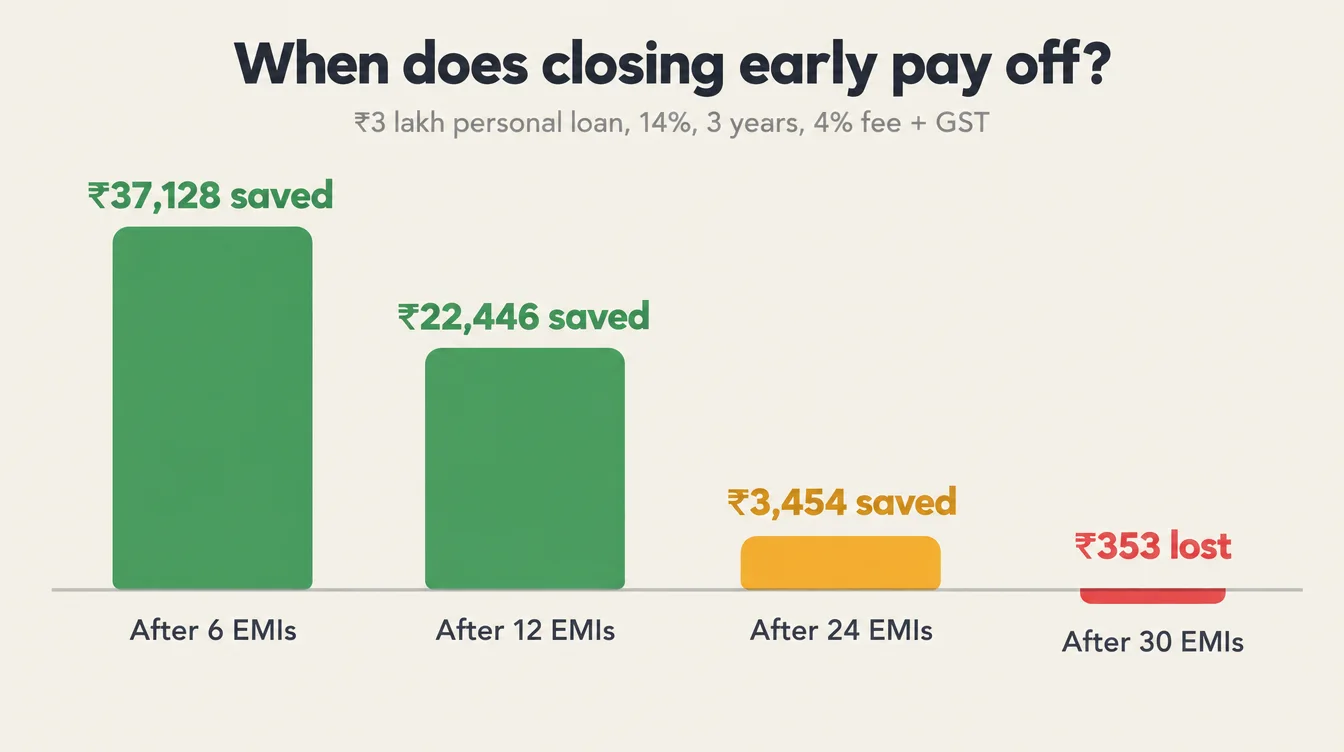
Estimates: interest worked out monthly on the balance; a 4% foreclosure fee plus 18% GST on the amount left. Your lender's fee and rules may differ.
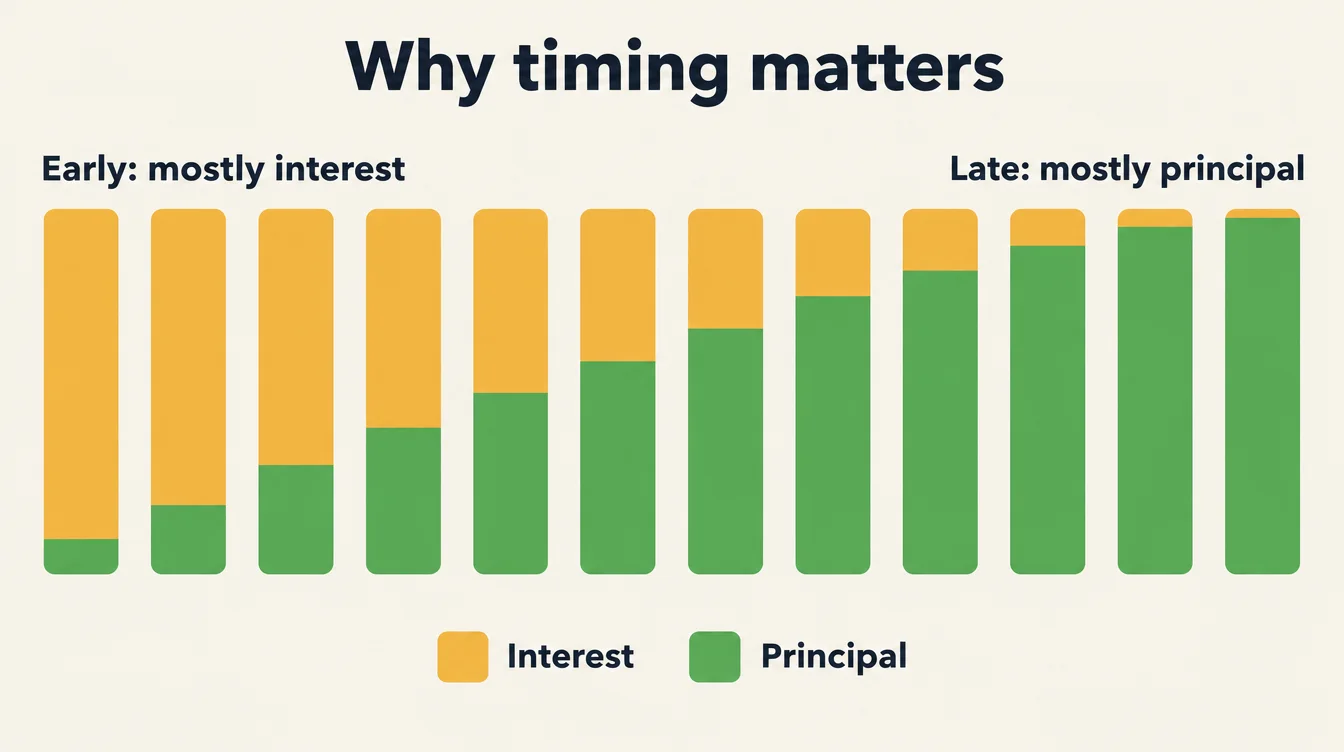
The pattern: closing early saves a lot, because most of each early EMI is interest. Closing near the end saves very little, because the remaining EMIs are mostly principal, and the fee can wipe out the saving. We explain why in how EMI is calculated.
Why the timing matters so much
On this loan, the first year's EMIs carry far more interest than the last year's. By month 30, only about ₹2,400 of interest is left in the whole loan, so a ₹2,800 fee costs more than it saves.
When closing early makes sense
- You're in the first half of the loan. That's where most of the interest is.
- The fee is low, or zero. Some lenders charge nothing after a lock-in.
- You'll still have an emergency buffer after paying. Don't empty your savings to close a loan.
- You don't have costlier debt. If you're carrying a credit card balance at about 42% a year, clear that first. It saves far more. See how to pay off credit card debt fast.
When it may not be worth it
- You're near the end of the loan. The fee may be bigger than the interest left.
- You're still in a lock-in period. You may not be allowed to, or the fee may be higher.
- It would leave you with no savings. One emergency could push you onto a credit card or an app loan, at a far higher rate.
How to check before you close
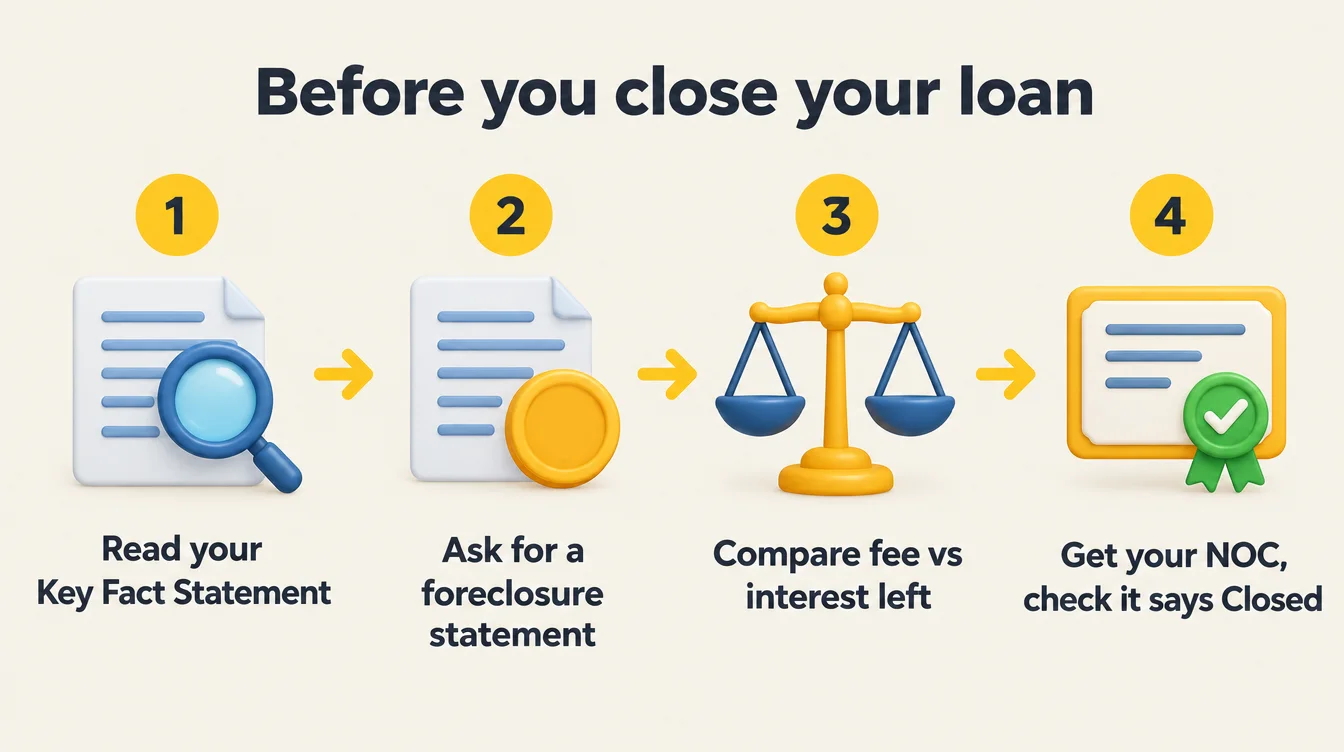
- Read your loan agreement or Key Fact Statement for the foreclosure fee and any lock-in.
- Ask the lender for a foreclosure statement. It shows the exact amount to pay today, including any fee and GST.
- Compare the fee with the interest left. If you have your loan schedule, the remaining interest is the total of the EMIs left minus the amount left.
- Pay only through official channels, and keep the receipt.
- Get a no-dues certificate (NOC) and check your credit report a month or two later to make sure the loan shows as "Closed", not "Settled". That matters for your CIBIL score.
Can't close it fully? Part-prepay instead
If you have some money but not enough to close the loan, a part-prepayment still cuts the interest, and is usually best done early. Ask if your lender allows it, what it charges, and whether it will reduce the tenure or the EMI. Reducing the tenure usually saves more, as we showed in the Diwali bonus guide.
The short version
- Closing early in a personal loan saves the most; closing near the end can save almost nothing.
- Most personal loans are fixed-rate, so foreclosure fees can apply, plus GST.
- Always ask for a foreclosure statement and compare the fee with the interest left.
- Keep an emergency buffer, and clear costlier debt first.
- After closing, get an NOC and check your report says "Closed".
The freeeme app shows how much interest is left on each loan, so you can see whether closing early is worth it, and how much sooner your family becomes debt-free.
Questions people ask
Are there foreclosure charges on personal loans?
Often, yes. Most personal loans have a fixed interest rate, and lenders can charge a foreclosure or prepayment fee on fixed-rate loans, often a few percent of what's left plus 18% GST. Some lenders charge nothing. Check your loan agreement or Key Fact Statement.
Do RBI's new prepayment rules apply to personal loans?
RBI rules effective from 1 January 2026 stop banks and NBFCs from charging prepayment fees on floating-rate loans to individuals for non-business purposes. Personal loans are usually fixed-rate, so these rules often don't cover them. If your personal loan is on a floating rate, they may.
Is it better to foreclose or part-prepay a personal loan?
If you can't clear the whole loan, a part-prepayment still saves interest, but check whether your lender allows it and what it charges. Some lenders allow part-payments only after a minimum number of EMIs.
This is general information to help you understand your options, not financial, legal or tax advice. Rates, rules and charges change; check your lender's latest terms before you decide.