How to improve your CIBIL score: 8 steps that work
A practical 8-step plan to raise your CIBIL score: fix report errors, clear overdue dues, cut card usage, and what to expect in 3, 6 and 12 months.

A low CIBIL score can mean a loan rejection, or a loan at a higher interest rate that costs you lakhs, as we showed in how EMIs affect your CIBIL score. The good news: your score isn't fixed. It follows your behaviour, and with the right steps it can recover.
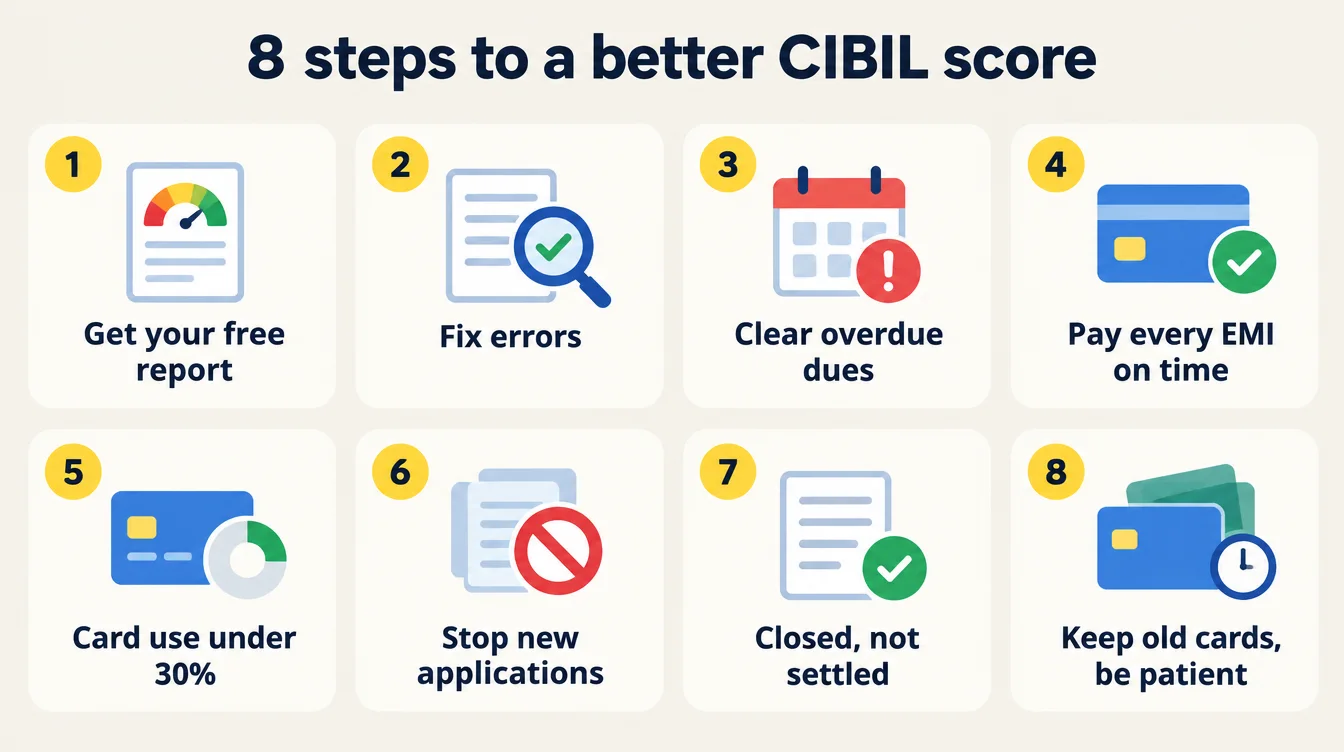
Here are 8 steps that work, in order, with a worked example and a realistic timeline.
Step 1: Get your free credit report
By RBI rules, every credit bureau, including TransUnion CIBIL, Experian, Equifax and CRIF High Mark, must give you one free full credit report a year. Get it from their official websites only. Checking your own report doesn't lower your score.
Step 2: Fix any errors
Look carefully for:
- Loans or cards that aren't yours
- Loans you've closed that still show as open
- Payments marked late that you made on time
- Wrong amounts, or the same loan listed twice
Raise a dispute on the credit bureau's website, or with your lender, and attach proof such as bank statements or a no-dues certificate. Under RBI rules, if a lender or bureau doesn't resolve your complaint within 30 days, you're entitled to ₹100 for every day of delay.
Step 3: Clear anything overdue first
An overdue EMI or card bill hurts your score every reporting cycle it stays unpaid, and lenders now report every fortnight. Pay overdue amounts before anything else, even before prepaying other loans. If you can't pay in full, talk to your lender about a plan, as explained in what happens if you miss an EMI.
Step 4: Pay every EMI and card bill on time
Payment history is the biggest part of your score. From now on, no late payments:
- Set auto-debit for EMIs and at least the card's minimum due.
- Move due dates to just after salary day where possible.
- Keep a small buffer, one month of EMIs, for bad months.
Then aim to pay the full card bill, not just the minimum. The minimum due avoids a late mark, but interest piles up fast.
Step 5: Get card usage under 30%
Your credit utilisation is how much of your total card limit you're using. High usage can pull your score down even if you never miss a payment.
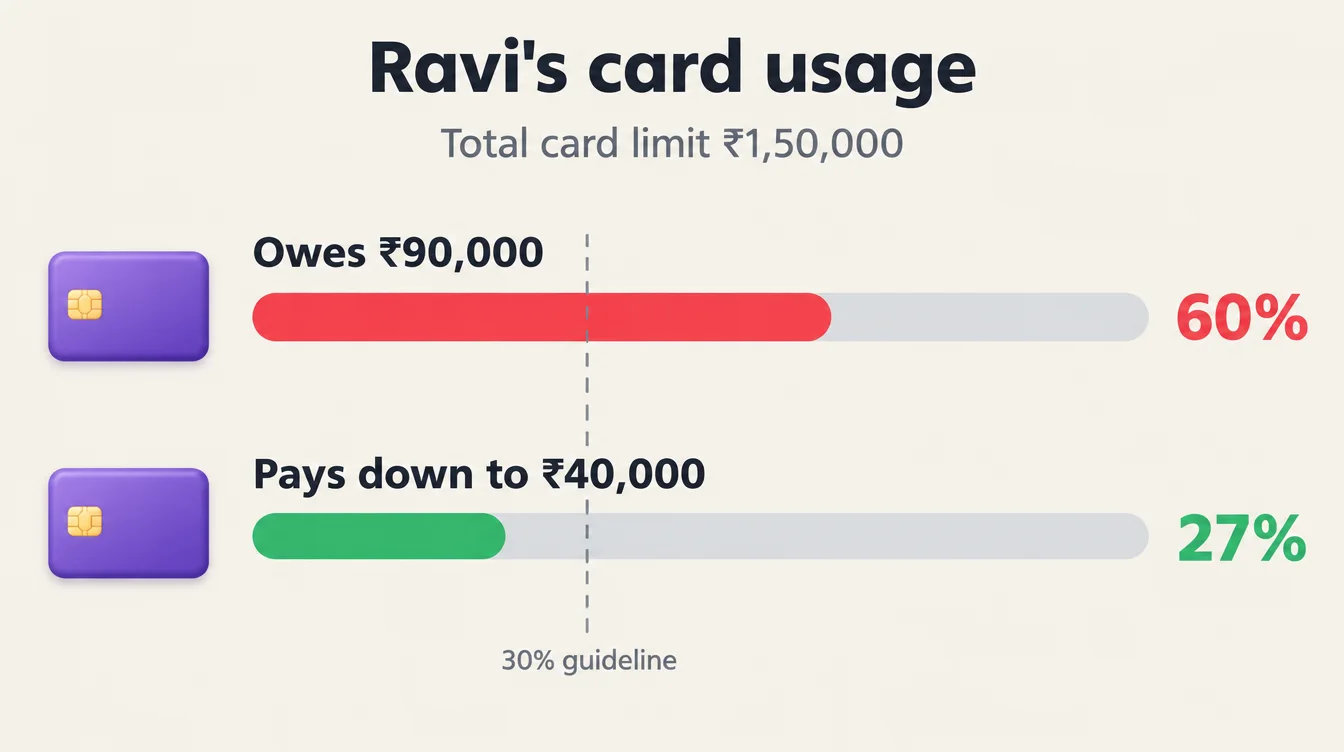
Example: Ravi has two cards with limits of ₹50,000 and ₹1,00,000, a total of ₹1,50,000. He owes ₹90,000 across both.
- ₹90,000 ÷ ₹1,50,000 = 60% usage. That can weigh on his score.
- If he pays the balance down to ₹40,000, usage drops to about 27%, under the common 30% guideline.
- If his bank also raised one limit so his total became ₹2,50,000, the same ₹90,000 would be 36%. A higher limit helps, as long as he doesn't spend more.
Step 6: Stop applying for new loans and cards
Every loan or card application lets the lender check your report, and many applications in a short time can lower your score and make you look desperate for credit. While you're rebuilding, apply only when you really need to, and avoid "check your eligibility" offers that run a full credit check.
Step 7: Close loans properly, "Closed" not "Settled"
When you finish a loan, make sure the lender reports it as Closed and get a no-dues certificate.
If an old loan shows as Settled (you paid less than you owed), it can hurt your score for years. If you can afford it, ask the lender what it would take to pay the remaining amount and have it updated to "Closed". Get the agreement in writing first.
Step 8: Keep old cards open, and be patient
The length of your credit history matters. An old card with a good record helps, so if it has no annual fee, consider keeping it open and using it lightly. Then give it time.
What to expect, and when
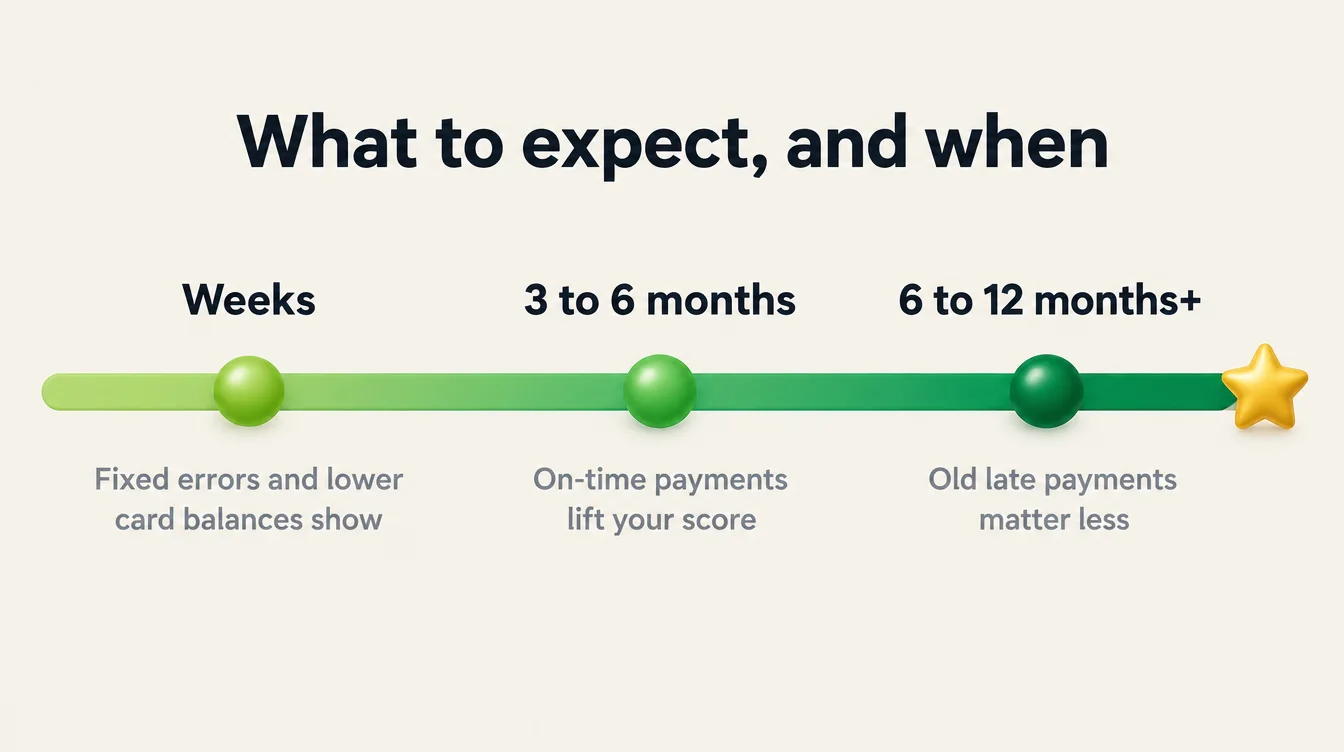
There's no fixed timeline, because every report is different. A rough guide:
| When | What can change |
|---|---|
| A few weeks to 2 months | Errors fixed, card balances paid down and overdue dues cleared start showing in your report |
| 3–6 months | A steady run of on-time payments begins to lift your score |
| 6–12 months and beyond | Older late payments matter less as your good record grows; recovering from a default or settlement takes longest |
Watch out for "credit repair" offers
Be careful of agents or apps that promise to "fix" or "boost" your CIBIL score for a fee. No one can remove correct information from your report. You can dispute real errors yourself, for free, with the credit bureau.
The short version
- Get your free report.
- Fix errors.
- Clear overdue dues.
- Pay everything on time.
- Keep card usage under 30%.
- Stop applying for new credit.
- Close loans as "Closed", not "Settled".
- Keep old cards, and be patient.
The freeeme app reminds you before every EMI and keeps all your due dates in one place, the simplest way to build the on-time record your score depends on.
Questions people ask
How fast can I improve my CIBIL score?
Fixing a report error or paying down card balances can show up within a few weeks, once lenders send their next update. Recovering from late payments or a default takes longer, often many months, because your payment history needs time to rebuild.
Does checking my own CIBIL score lower it?
No. Checking your own score or report is a soft enquiry and doesn't affect it. Only lender enquiries when you apply for a loan or card can lower it.
Will closing my old credit card improve my score?
Usually not. Closing a card reduces your total credit limit, which can push your usage percentage up, and may shorten your credit history. If the card has no fee and you can manage it, keeping it open and unused is often better.
This is general information to help you understand your options, not financial, legal or tax advice. Rates, rules and charges change; check your lender's latest terms before you decide.