How is EMI calculated? The formula, explained simply
The EMI formula in plain words, a ₹5 lakh loan worked out step by step, why early EMIs are mostly interest, and how tenure changes what you pay.

An EMI, or equated monthly instalment, is the fixed amount you pay every month until a loan is cleared. Banks show you the number, but rarely how they got it. Once you understand how EMI is calculated, you can see exactly where your money goes, and why the first few years of a loan feel like they barely move.
Here's the formula in plain words, worked out on a ₹5 lakh loan.
The EMI formula
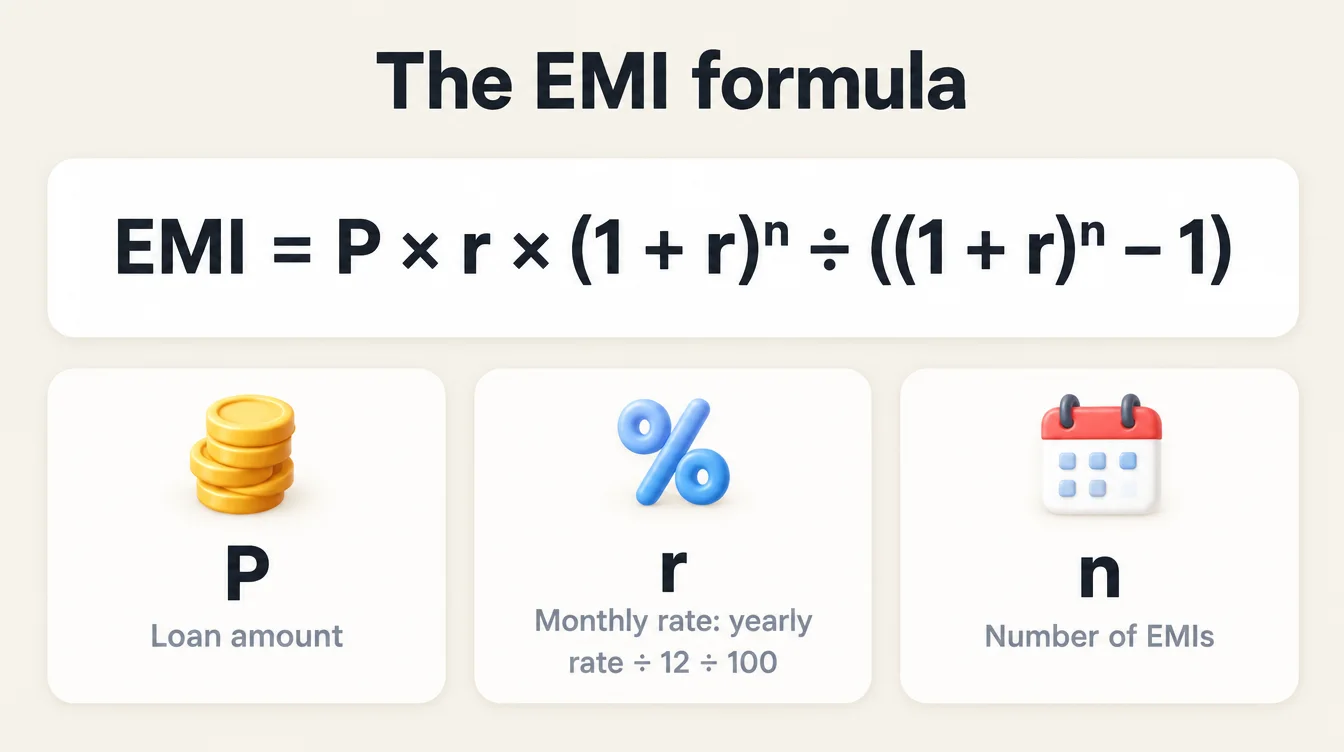
Every bank and NBFC uses the same standard formula for reducing-balance loans:
EMI = P × r × (1 + r)^n ÷ ((1 + r)^n − 1)
- P = the loan amount (principal)
- r = the monthly interest rate: yearly rate ÷ 12 ÷ 100
- n = the number of monthly EMIs
A worked example: ₹5 lakh at 10% for 5 years
- P = ₹5,00,000
- r = 10 ÷ 12 ÷ 100 = 0.008333
- n = 5 years × 12 = 60
Put them into the formula and you get an EMI of ₹10,624.
Over 60 months you pay ₹10,624 × 60 = ₹6,37,411. That's the ₹5 lakh you borrowed plus ₹1,37,411 in interest.
Figures are rounded to the nearest rupee. Your lender's numbers may differ slightly because of rounding or the exact dates of payment.
Where each EMI actually goes
Every EMI has two parts: interest on what you still owe, and principal that reduces the loan.
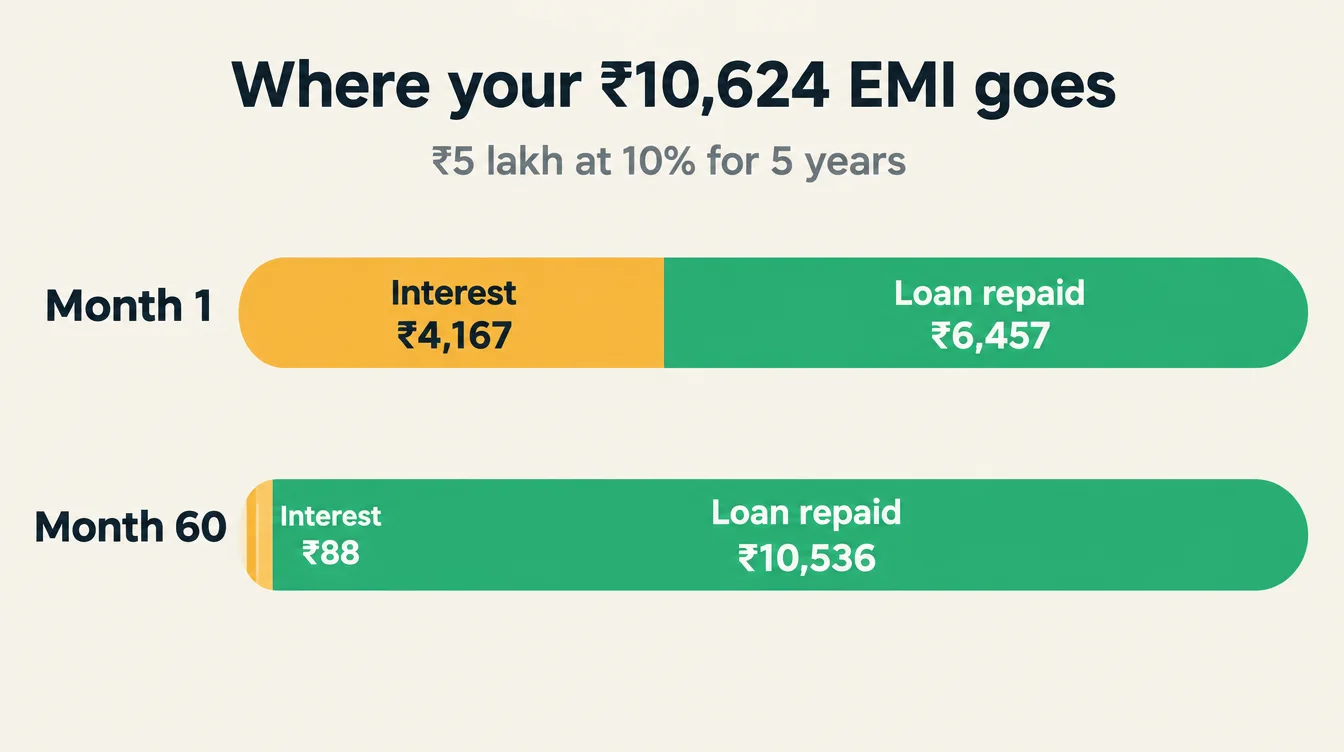
Month 1: you owe ₹5,00,000. Interest for the month is ₹5,00,000 × 0.008333 = ₹4,167. The rest, ₹6,457, reduces your loan.
Month 60: you owe only about ₹10,500. Interest is just ₹88, and ₹10,536 clears the loan.
Same EMI, very different split. Here's how it looks year by year:
| Year | Interest paid | Loan repaid |
|---|---|---|
| Year 1 | ₹46,348 | ₹81,134 |
| Year 2 | ₹37,852 | ₹89,630 |
| Year 3 | ₹28,467 | ₹99,015 |
| Year 4 | ₹18,099 | ₹1,09,383 |
| Year 5 | ₹6,645 | ₹1,20,837 |
This is why prepaying early saves the most. Any extra you pay in the first years cuts the balance while interest is at its highest. We worked through the numbers in Got a Diwali bonus? Prepay your loan or keep the cash?
How tenure changes your EMI and total interest
The same ₹5 lakh at 10%, over different tenures:
| Tenure | EMI | Total interest |
|---|---|---|
| 3 years | ₹16,134 | ₹80,809 |
| 5 years | ₹10,624 | ₹1,37,411 |
| 7 years | ₹8,301 | ₹1,97,250 |
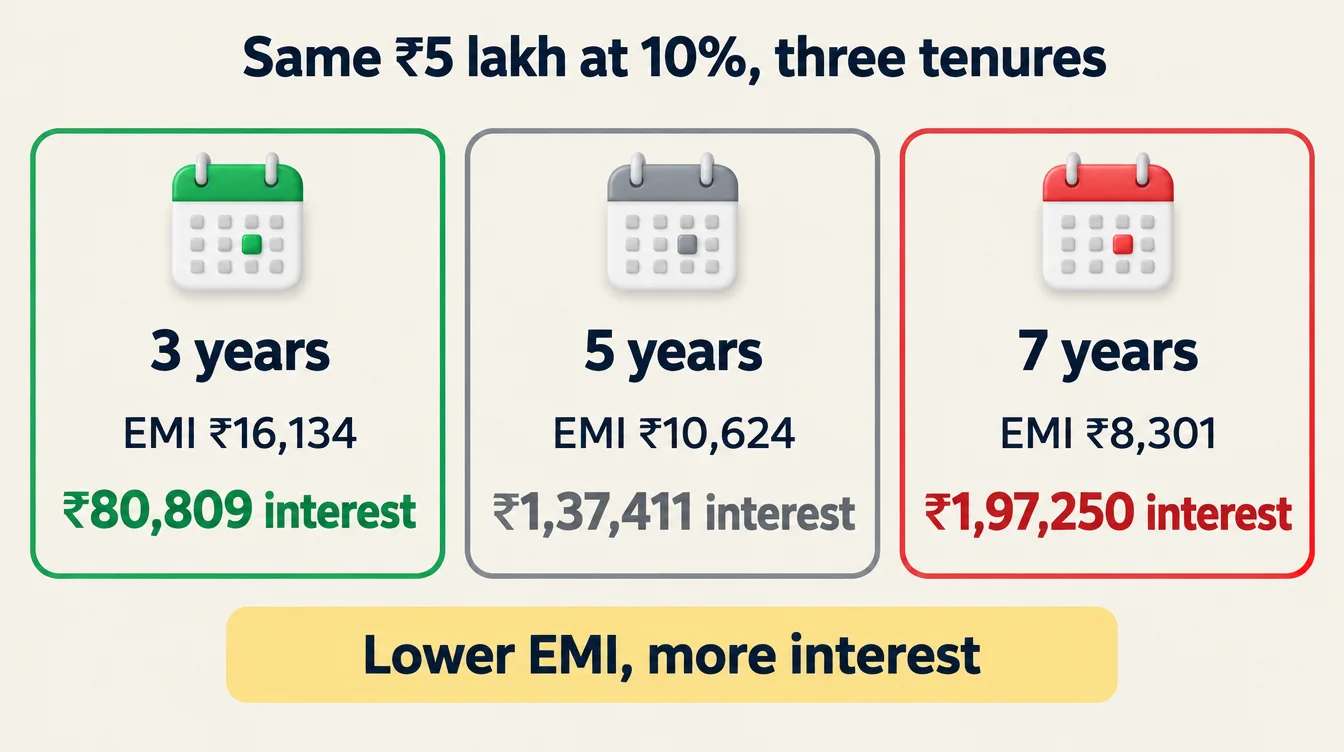
A longer tenure makes the EMI easier, but you pay much more overall. Going from 5 to 7 years cuts the EMI by about ₹2,300, and adds about ₹60,000 in interest. Pick the shortest tenure whose EMI still fits comfortably, as explained in how much EMI can I afford on my salary.
Watch out for "flat rate" loans
Some lenders, especially for consumer goods, two-wheelers or small personal loans, quote a flat interest rate. Flat interest is charged on the original loan amount for the whole tenure, even as you repay it.
On ₹5 lakh at a 10% flat rate for 5 years:
- Interest = ₹5,00,000 × 10% × 5 = ₹2,50,000
- EMI = (₹5,00,000 + ₹2,50,000) ÷ 60 = ₹12,500
That's ₹1,12,589 more interest than the same 10% on a reducing balance. A "10% flat" loan really costs close to double the headline rate. Always ask: is this rate flat or reducing?
Check your EMI yourself
You don't need to do the maths by hand. In any spreadsheet, type:
=PMT(10%/12, 60, -500000)
Change the rate, number of months and loan amount to match your loan. If the bank's EMI is very different, ask why: there may be fees, insurance or a flat rate built in.
The short version
- EMI = P × r × (1 + r)^n ÷ ((1 + r)^n − 1), with r as the monthly rate.
- Early EMIs are mostly interest; later ones are mostly principal.
- Longer tenure = lower EMI, much higher total interest.
- Flat rates cost far more than the same reducing rate.
The freeeme app works out every loan's EMI split for you, and shows how much sooner your family is debt-free if you pay a little extra.
Questions people ask
What is the formula for EMI?
EMI = P × r × (1 + r)^n ÷ ((1 + r)^n − 1), where P is the loan amount, r is the monthly interest rate (the yearly rate divided by 12 and by 100), and n is the number of monthly EMIs.
Why does most of my early EMI go to interest?
Interest is charged on what you still owe. At the start you owe the most, so the interest part is biggest. As the balance falls, interest shrinks and more of each EMI repays the loan.
Is a longer tenure better because the EMI is lower?
A longer tenure lowers the EMI but raises the total interest you pay. On a ₹5 lakh loan at 10%, stretching from 5 to 7 years cuts the EMI by about ₹2,300 but adds about ₹60,000 in interest.
This is general information to help you understand your options, not financial, legal or tax advice. Rates, rules and charges change; check your lender's latest terms before you decide.