How to save for yearly expenses: the sinking fund method
Insurance, school fees, Diwali: yearly bills that wreck the monthly budget. How a simple sinking fund turns ₹1.08 lakh of yearly bills into ₹9,000 a month.

Every family has them: the bills that come once a year and wreck that month's budget. Health insurance in March. School fees in June. Car insurance in September. Diwali in November. Each time, the money has to come from somewhere, and too often that's a credit card, a personal loan or an "EMI option" at checkout.
A sinking fund fixes this. You save a small amount every month for each yearly bill, so when it arrives, the money is already waiting. Here's how it works, with a family's yearly bills in rupees.
What a sinking fund is
A sinking fund is just a pot of money for one known future bill. You:
- Know the bill and roughly how much it will be.
- Know when it's due.
- Divide the amount by the months left, and set that aside every month.
It's not an investment and it's not an emergency fund. It's a plan for bills you already know about.
A worked example: the Nair family's yearly bills
The Nairs list every bill that comes once or twice a year:
| Yearly bill | Amount | Save each month |
|---|---|---|
| Health insurance | ₹24,000 | ₹2,000 |
| School fees | ₹36,000 | ₹3,000 |
| Car insurance | ₹12,000 | ₹1,000 |
| Diwali and gifts | ₹30,000 | ₹2,500 |
| Property tax | ₹6,000 | ₹500 |
| Total | ₹1,08,000 | ₹9,000 |
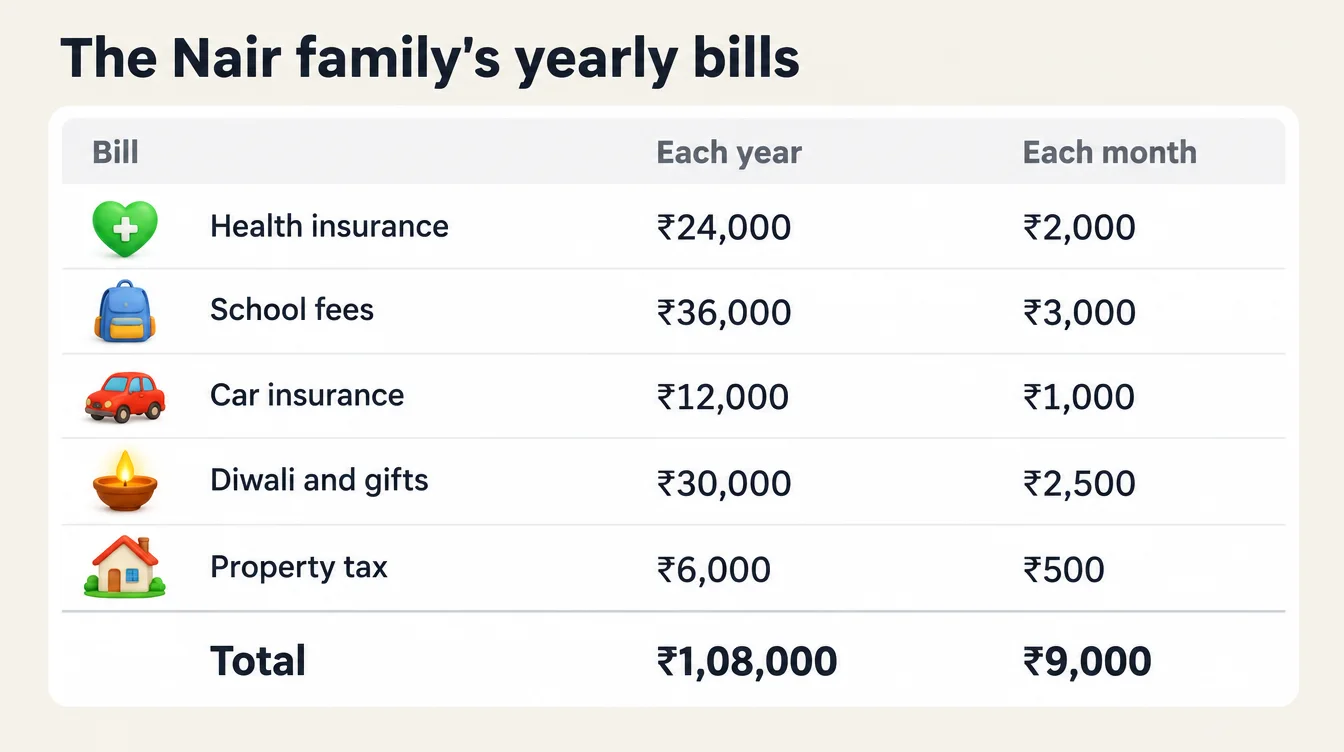
₹1.08 lakh a year feels impossible. ₹9,000 a month is a plan.
Why it matters: what happens without it
Say the ₹36,000 school fees go on a credit card, and the family pays ₹5,000 a month to clear it. At a typical 3.5% a month plus GST, that takes 9 months and costs about ₹7,600 in interest and GST, more than two months of the school fund itself.
Do that with two or three yearly bills, and you're carrying card debt all year, every year. That's how families slide into the minimum due trap or end up with too many EMIs.
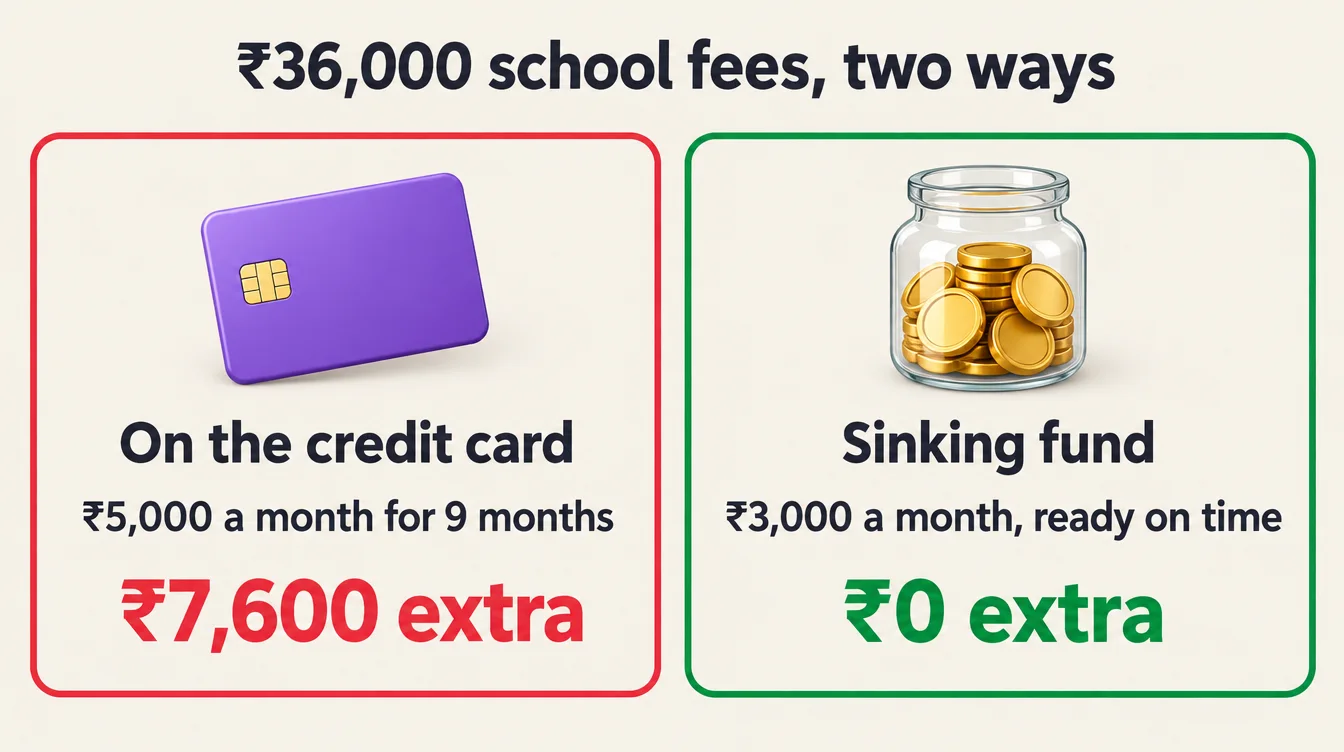
Estimate: card interest at 3.5% a month plus 18% GST, worked out monthly.
How to set up your sinking funds
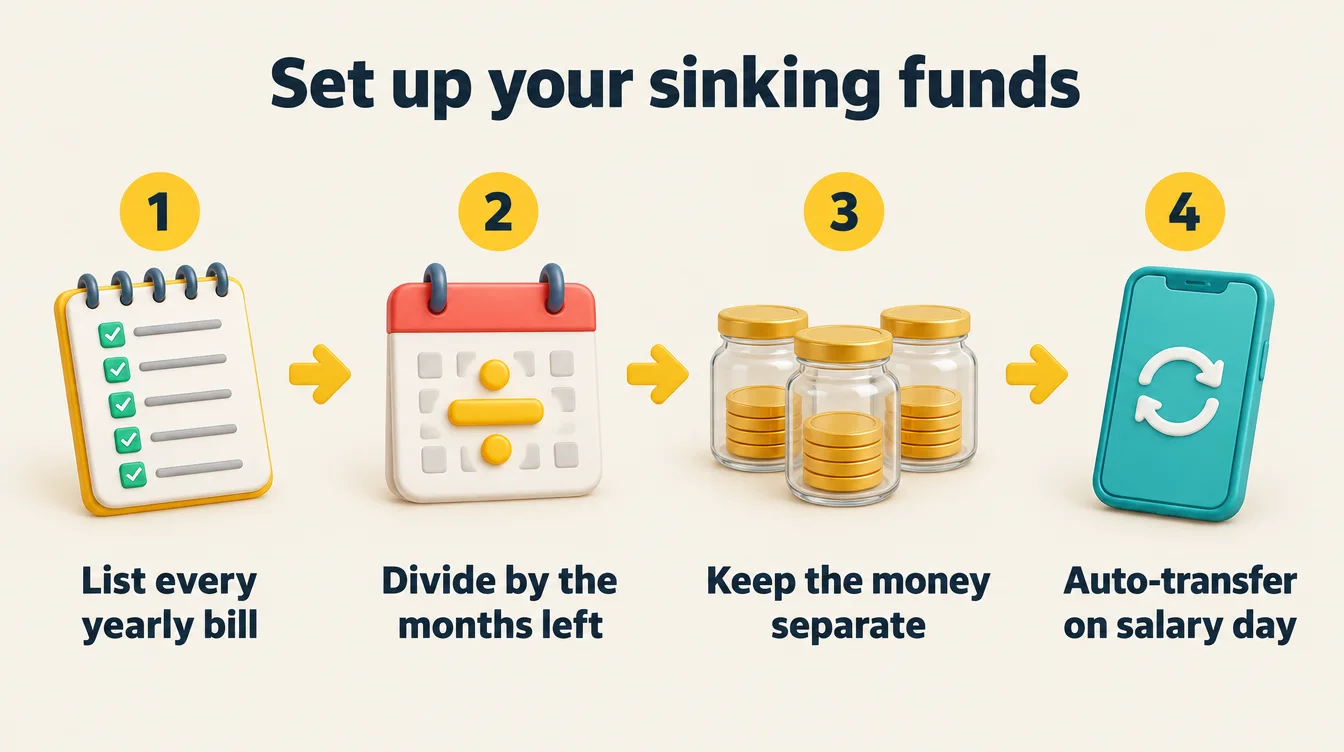
Step 1: List every yearly or occasional bill
Go through last year's bank statements and card bills. Look for:
- Insurance: health, life, car, two-wheeler
- Education: school or college fees, books, uniforms
- Festivals and functions: Diwali, Onam, Pongal, Eid, Christmas, weddings, birthdays
- Home: property tax, society maintenance, appliance repairs
- Travel: a yearly trip home
- Vehicle: servicing, tyres
Step 2: Divide by the months left
If the bill is 12 months away, divide by 12. If it's only 5 months away, divide by 5. For example, ₹36,000 school fees due in 5 months means about ₹7,200 a month for now, then ₹3,000 a month after that.
Step 3: Keep it separate
Money mixed into your daily account gets spent. Use:
- A separate savings account just for yearly bills, or
- A recurring deposit timed to mature just before the bill, or
- Separate pots or "jars" for each bill, so you can see each one filling up.
Step 4: Automate it on salary day
Set up an auto-transfer on salary day, before you spend anything else. Treat it like an EMI that you're paying to your future self.
Tips that make it work
- Start with the next two bills, not all of them. Add more as your budget allows.
- Round up. Prices and premiums rise, so add 5–10%.
- Use windfalls to catch up. A bonus can top up a fund that's behind. See what to do with a Diwali bonus.
- Don't raid one fund for another, unless it's a real emergency.
- Keep an emergency fund too. Sinking funds are for known bills; an emergency fund is for surprises.
Where this fits in your money plan
A sinking fund doesn't replace paying off debt; it stops new debt. Once your yearly bills stop landing on the credit card, the plan in how to get out of debt in India gets much easier, because nothing new keeps adding to the pile.
Keep your total monthly commitments, EMIs plus sinking funds, within what your take-home pay can carry. Our EMI affordability guide helps you check.
The short version
- List every yearly bill.
- Divide each by the months left.
- Keep the money separate.
- Auto-transfer it on salary day.
- Pay yearly bills in full, with no card and no EMI.
The freeeme app has money jars built for exactly this: set a jar for each yearly bill, see how much to put aside each month, and watch it fill up before the bill arrives. Your jars stay private to you, and the money stays in your own bank account.
Questions people ask
What is a sinking fund?
A sinking fund is money you set aside a little every month for a bill you know is coming later, like insurance, school fees or a festival. When the bill arrives, the money is already there, so you don't need a loan or a credit card.
Where should I keep my sinking fund?
Somewhere safe and easy to reach, but separate from your daily spending: a separate savings account, a recurring deposit timed to the bill, or a clearly labelled pot. Keep it away from anything risky, since you'll need the full amount on a fixed date.
Is a sinking fund the same as an emergency fund?
No. An emergency fund is for surprises you can't plan, like a job loss or hospital stay. A sinking fund is for bills you know are coming. Keep them separate, so one doesn't eat the other.
This is general information to help you understand your options, not financial, legal or tax advice. Rates, rules and charges change; check your lender's latest terms before you decide.