Is converting credit card dues to EMI worth it?
Card bill too big to pay? ₹60,000 worked out four ways: minimum due, revolving, card EMI conversion and a personal loan, with the hidden charges.
The festive season is over and the card bill has arrived: ₹60,000. You can't pay it all this month. The bank's app offers a button: "Convert to EMI."
For a balance you can't pay in full, converting to EMI is usually far cheaper than paying only the minimum due or carrying the balance. But it isn't free, and it's not always the cheapest option. Here's ₹60,000 worked out four ways.
What "convert to EMI" means
The bank takes your outstanding amount, or a big purchase, off your normal bill and turns it into fixed monthly instalments, often for 3 to 24 months. You pay:
- Interest, usually much lower than the normal card rate of about 3–3.75% a month
- 18% GST on that interest
- Often a processing fee, plus GST
The rate, fee and tenures differ by bank and card, so check the offer in your app.
₹60,000 worked out four ways
| Option | Monthly payment | Time to clear | Interest + GST + fees |
|---|---|---|---|
| Pay only the minimum due | starts at about ₹3,100 and falls | about 17 years | about ₹2.03 lakh |
| Carry the balance, pay ₹5,490 a month | ₹5,490 | 15 months | about ₹21,450 |
| Convert to card EMI, 12 months | about ₹5,490 | 12 months | about ₹6,590 |
| Personal loan, 12 months | ₹5,359 | 12 months | about ₹5,720 |
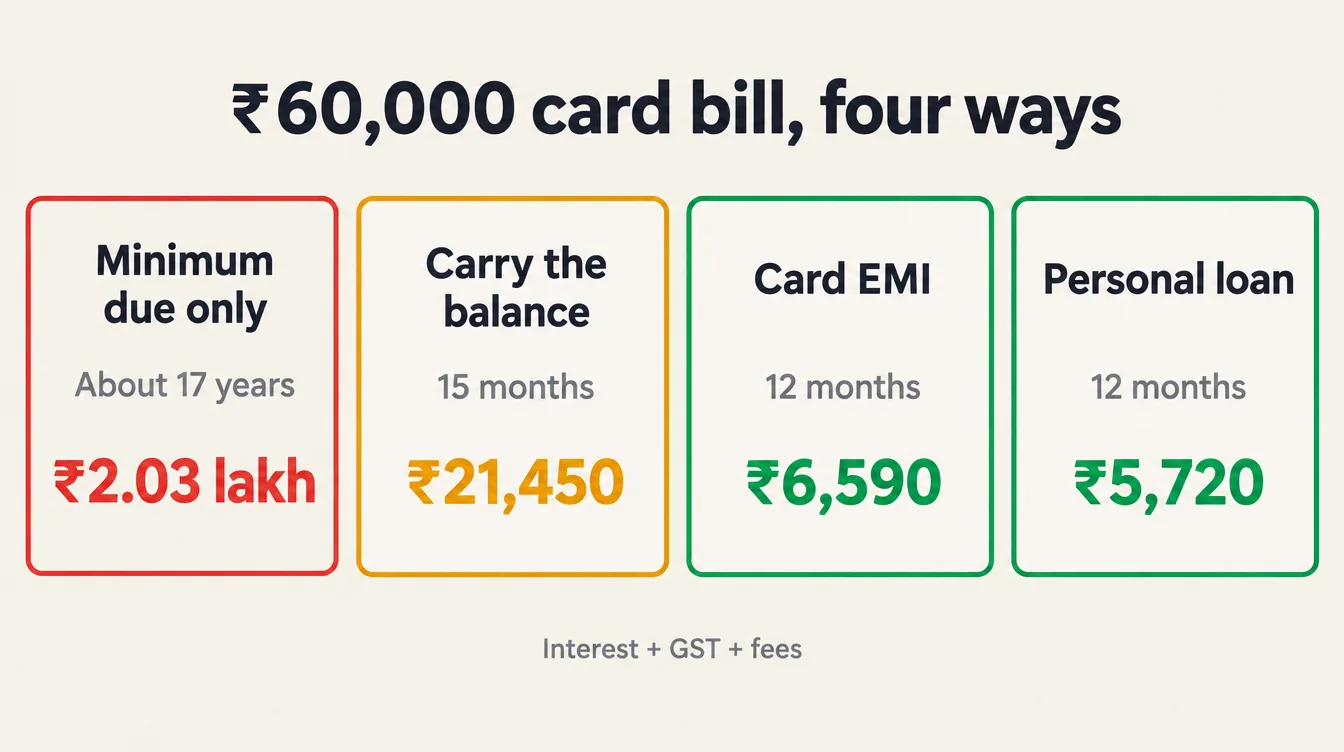
Estimates: card interest at 3.5% a month plus 18% GST; a minimum due of 5% (at least ₹500) with no new spending; card EMI at 15% a year with GST on interest and a 1% processing fee plus GST; personal loan at 13% a year with a 2% processing fee plus GST. Your bank's numbers will differ.
Three things stand out:
- Paying only the minimum due is by far the worst. It's the minimum due trap.
- Converting to EMI saves about ₹14,900 compared with carrying the balance at the same monthly payment, and finishes 3 months sooner.
- A personal loan can be slightly cheaper, about ₹870 less here, but it needs a new loan application, a credit check and approval. For a small amount, card EMI is often simpler.
Where the card EMI cost comes from
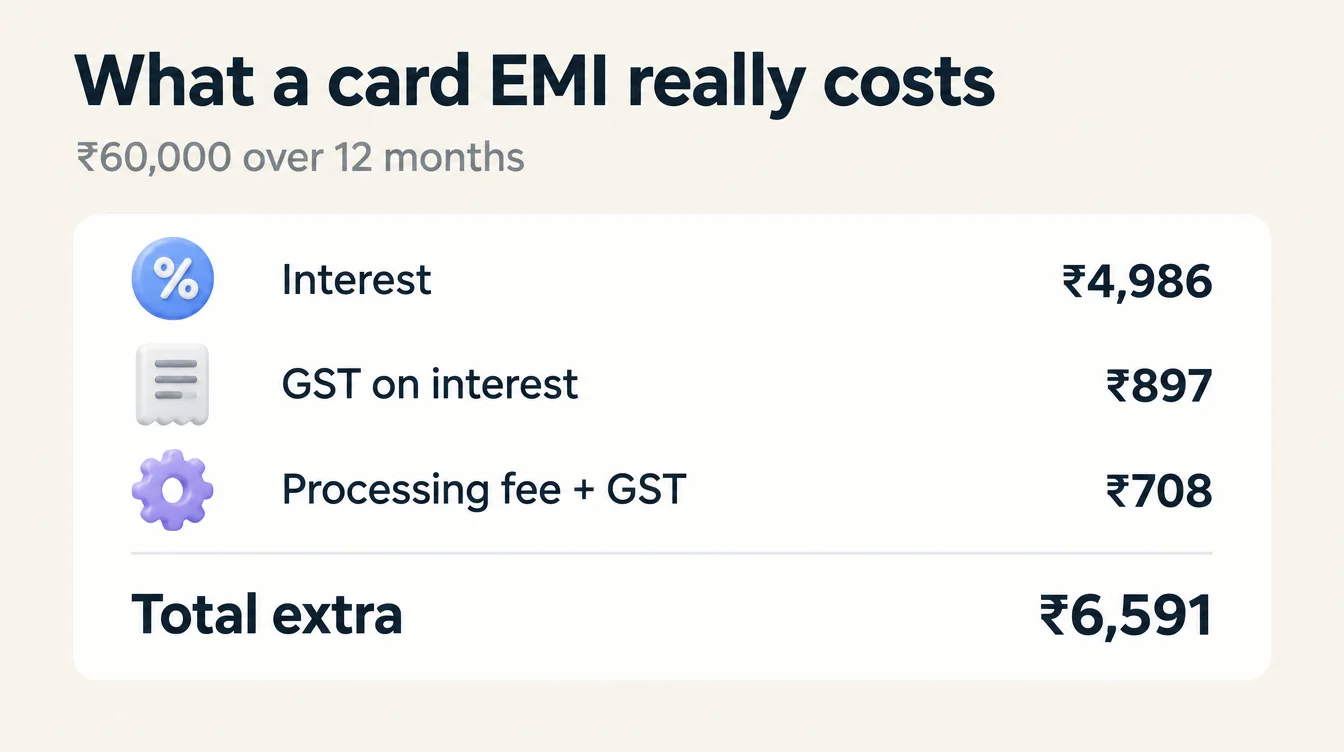
On the ₹60,000, 12-month card EMI:
- Interest: about ₹4,986
- GST on interest: about ₹897
- Processing fee with GST: about ₹708
- Total extra: about ₹6,591
The catches to know
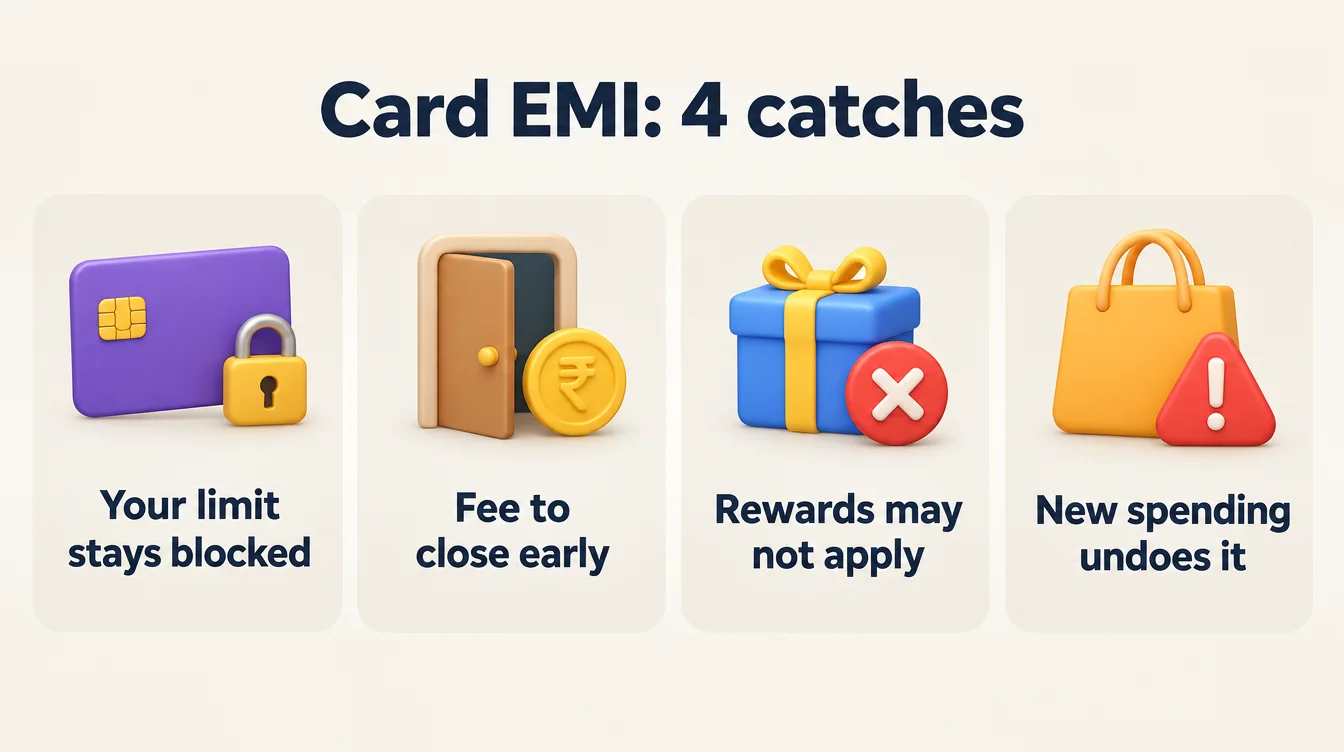
1. Your limit stays blocked. The converted amount usually stays against your card limit until it's repaid, so your credit utilisation stays high. That can hold your CIBIL score down for a few months, even if you pay on time.
2. Foreclosure fees. Want to clear it early with a bonus? Many banks charge a fee for closing an EMI early. Check before you convert.
3. Rewards and offers. Converted amounts often don't earn reward points, and some banks reverse cashback on purchases that are later converted.
4. It only works if you stop adding to the card. If new spending keeps piling up on the same card, you'll be paying an EMI and a growing balance at the same time. Use UPI or a debit card until the EMI is done.
5. One more EMI on your list. Add it to your other EMIs and check the total still fits, using how much EMI can I afford on my salary.
When converting to EMI makes sense
- You can't pay the full bill this month or next.
- You can pay the EMI every month without strain.
- You'll stop new spending on that card until it's done.
- The total cost is clearly lower than carrying the balance, which it almost always is.
When something else may be better
- You can pay the full bill within a month or two. Paying it off quickly may cost less than a 12-month EMI with fees.
- You have several cards or loans. A step-by-step plan that clears the most expensive debt first may beat converting each card separately.
- The fee is high and the tenure is short. A flat processing fee on a 3-month EMI can make the effective cost surprisingly high. Compare the total.
A quick checklist before you tap "Convert"
- What's the interest rate, and is it on a reducing balance?
- What's the processing fee, and is GST extra?
- Is there a foreclosure fee if I close it early?
- What's the total I'll pay, compared with paying the bill off myself?
The freeeme app keeps your card EMIs alongside every other loan, so you can see what one more EMI does to your family's debt-free date before you convert.
Questions people ask
Does converting a credit card bill to EMI affect my CIBIL score?
Converting itself doesn't hurt your score, and paying the EMIs on time helps it. But the converted amount usually keeps your card limit blocked until it's repaid, so your credit utilisation stays high for a while.
Is there GST on credit card EMI?
Yes. GST at 18% is charged on the interest part of each EMI and on any processing fee. Add it when you compare the real cost.
Can I close a credit card EMI early?
Usually yes, but many banks charge a foreclosure fee, often a small percentage of what's left, plus GST. Check your bank's terms before you convert.
This is general information to help you understand your options, not financial, legal or tax advice. Rates, rules and charges change; check your lender's latest terms before you decide.